


How satire became more powerful than any manifesto ever written
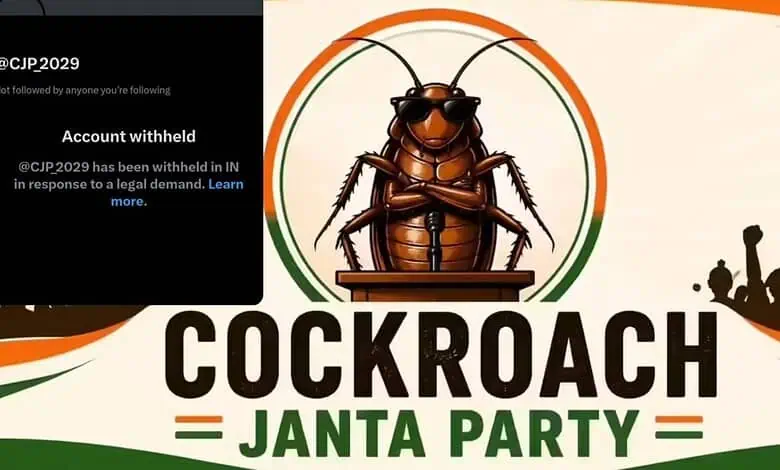
The account disappeared from X without warning. One day it was there, accumulating followers at a staggering rate. The next, it was gone—blocked, shadowbanned, or deleted. The Cockroach Janata Party’s presence on Elon Musk’s platform simply vanished.
On Instagram, meanwhile, the same account was breaking engagement records. Its reach dwarfed established political parties. Its posts were being shared more than mainstream media coverage of actual elections.
This wasn’t a setback for the movement. It was a confirmation.
When a platform mutes you, it proves you’ve said something they’re afraid of. When millions of people keep sharing your message anyway, it proves the system is no longer in control of the narrative. The Cockroach Janata Party had achieved something unprecedented: it had become simultaneously suppressed and unstoppable.
The Death of Political Language (And What Replaced It)
Traditional politics speaks in policy papers, legislative frameworks, and carefully calibrated rhetoric designed to offend no one and mean everything. It is language engineered for control—precise, hierarchical, gatekept by party elites and media institutions.
Then came the internet.
Gen Z grew up in a world where the official channel and the meme channel coexist. They watch Prime Minister speeches and Instagram Reels in the same scroll. They’ve seen countless political promises dissolve into nothing. They’ve witnessed institutional failure broadcast in real-time across multiple platforms. And they’ve learned to respond not with outrage performed for traditional media, but with irony, subversion, and collective mockery.
The Cockroach Janata Party is the apotheosis of this shift. It doesn’t ask you to respect it. It doesn’t perform seriousness. Instead, it says: Your institutions are a joke, so we’re turning jokes into institutions.
Abhijeet Dipke, the strategist behind the movement, understood something that most political operatives still don’t: authenticity in the digital age isn’t about polish. It’s about refusal. It’s about saying what everyone is thinking but no one in power dares speak aloud. It’s about humor that cuts, irreverence that stings, and demands wrapped in comedy because comedy is the only language the establishment can’t co-opt.
Why Satire Works When Everything Else Fails
In a hyperpartisan landscape where every statement is weaponized and every position is a culture war battle, satire occupies a unique space. It allows you to speak truth while maintaining plausible deniability. It permits rage without demanding you be respectable. It creates community among the alienated by turning alienation itself into the basis for belonging.
More importantly, satire spreads.
A policy document on unemployment gets read by policy wonks. A news report on youth joblessness gets buried beneath other news cycles. But a meme that says “we are cockroaches and we’re organizing” spreads like a virus because it feels like something authentic that someone secretly recorded, not something a political machine manufactured.
The Cockroach Janata Party’s refusal to perform seriousness is, paradoxically, what makes it serious. Its demand that young people be heard is wrapped in comedy so sharp it draws blood. Its manifesto for accountability is delivered with a shrug and a smirk that says: we don’t believe in this either, but at least we’re honest about it.
This is the new political language. And it’s terrifying to the old guard because it can’t be packaged, cannot be controlled, and refuses to play by rules the establishment invented.
The Platform Wars as Political Theater
X’s decision to block the account should be examined not as a technical moderation decision but as a political statement. By removing the Cockroach Janata Party, X’s algorithm effectively endorsed a narrative: this movement is too dangerous to amplify.
The irony was exquisite. The block became proof of concept. It validated the movement’s central claim: that the system is rigged, that dissent is suppressed, and that those in power will move against you if you become too effective.
Meanwhile, Instagram—a platform historically friendly to youth culture and visual storytelling—became the Cockroach Janata Party’s stronghold. The movement’s engagement metrics outpaced major political parties. Its reach penetrated demographics that traditional media still struggles to access. Its content was being shared not because algorithms forced it into feeds, but because it meant something to the people sharing it.
This is what happens when you move beyond the “earn the right to be heard” framework that defined 20th-century activism. The Cockroach Janata Party didn’t ask for a press conference. It didn’t petition for airtime on news channels. It simply built something on the platforms where young people actually gather—and then forced the establishment to respond to its existence.
The Real Crisis: Unemployment, Not Just Memes
Beneath the satire lies a brutal economic reality that traditional politics has failed to address. India’s youth unemployment crisis is not a talking point or a policy lever. It is lived experience. Millions of educated young people cannot find work. The promise that education leads to opportunity has been revealed as a lie.
This is where the Cockroach Janata Party’s genius becomes apparent. It doesn’t just crack jokes about the system. It articulates a specific, material grievance: you have failed to give us jobs, and then you have the audacity to mock us for struggling.
The movement’s demands are straightforward. Accountability in voter deletion. Anti-defection rules with actual teeth. Reservations for women. An end to post-retirement sinecures for judges. These aren’t radical demands. They’re basic institutional hygiene. But they’re being delivered in a form that the establishment cannot ignore or sanitize.
Traditional politics would frame these demands as complaints. The Cockroach Janata Party frames them as insults wrapped in laughter, criticism disguised as comedy, rage dressed up as absurdity. In doing so, it makes the demands impossible to dismiss without appearing to defend the very corruption it’s calling out.
The Weaponization of Irreverence
What the Cockroach Janata Party has discovered—and what other movements will inevitably replicate—is that irreverence has become a form of power. When you refuse to play the game by the establishment’s rules, when you use humor as a shield against co-option, when you make it clear that you don’t need permission or validation from traditional institutions, you create something the system has no tools to suppress.
You can ignore a protest march. You can discredit an activist. You can dismiss an NGO. But you cannot suppress a cultural mood that has achieved critical mass. You cannot block every person who shares the joke. You cannot algorithm-proof a message that has already entered the collective consciousness.
The Cockroach Janata Party understood this intuitively. By framing itself as “just a meme,” it made itself un-suppressible. By refusing to become a formal organization, it became impossible to co-opt. By embracing absurdity, it made itself immune to the usual tactics of institutional power.
This is the political innovation of the moment. Not better messaging, not smarter policy, not more effective campaigning. But the refusal to participate in the language game that has defined politics for centuries.
What Comes Next?
Will the Cockroach Janata Party become an electoral force? Probably not. That’s not the point. The movement’s significance lies not in whether it transforms into a political party but in what it reveals about the exhaustion of traditional politics and the emergence of new forms of collective action.
The account block on X may fade from memory. But the moment will not. A generation has learned that the establishment fears satire more than it fears confrontation. They’ve learned that irreverence is a viable political strategy. They’ve learned that when you refuse to ask for a seat at the table, sometimes the table collapses entirely.
In the emerging landscape of digital politics, this distinction matters profoundly. The future doesn’t belong to those who can deliver the most compelling manifesto. It belongs to those who can mobilize the most authentic expression of collective rage—and make the establishment so uncomfortable with that rage that they are forced to respond.
The Cockroach Janata Party is not the future of politics. But it is a symptom of the future’s arrival. And symptoms, by definition, come before the diagnosis.
The diagnosis, when it comes, will be undeniable: a generation has lost faith in the system. They are no longer waiting for change. They are building power in the spaces the establishment abandoned.
And they are doing it with memes, satire, and a refusal to be respectable.
The Larger Reckoning
This story extends far beyond India. Across democracies worldwide, young people are abandoning traditional activism for digital vernaculars that feel authentic, immediate, and impossible to co-opt. TikTok activism, meme-based organizing, and decentralized movements built on inside jokes—these are not distractions from “real” politics. They are the emergence of political forms that the 20th century didn’t prepare us for.
The Cockroach Janata Party is simply the most articulate expression of a global phenomenon: the exhaustion of traditional political language and the rise of new dialects of dissent.
The establishment should take note. Satire, once dismissed as entertainment, has become a mode of power. And a generation that communicates in irony cannot be managed through sincerity.
The revolution will not be televised. It will be memed into existence. And by the time the gatekeepers realize what’s happened, it will already have spread beyond their capacity to control.