

A Chief Justice called them “cockroaches.” They laughed, organized, and changed the game.
On a day like any other, Chief Justice Surya Kant made a remark that would inadvertently spark a political firestorm. He compared unemployed youth to “cockroaches”—creatures desperately scrambling for survival in a world with no room for them. The comment was meant to illustrate a point about desperation. Instead, it became a mirror held up to the face of India’s political establishment.
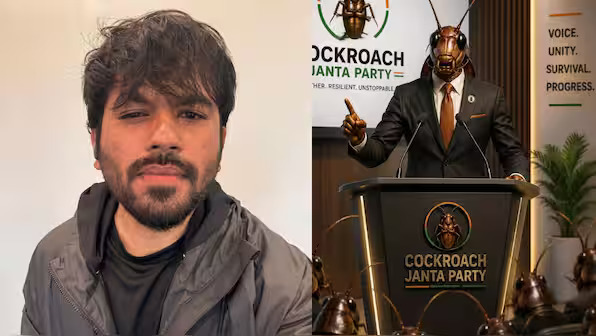
Rather than protest in anger, a 30-something communication strategist named Abhijeet Dipke did something bold: he weaponized the insult. Within days, the “Cockroach Janata Party” was born—and it exploded across social media with the velocity of a movement that had been waiting to happen.
Tens of thousands signed up. Memes multiplied. Gen Z users flooded the comments with a message that resonated far beyond the initial outrage: You called us cockroaches? Fine. We’re organizing.
What started as satire had become something else entirely—a articulation of a generation’s rage, exhaustion, and complete loss of faith in traditional politics.
The Man Behind the Movement
Abhijeet Dipke is not your typical political disruptor. He studied journalism in Pune, educated himself further in the United States, and earned a master’s degree in public relations from Boston University. His thesis explored how communication shapes perception—a question that would later define his life’s work.
Before launching the Cockroach Janata Party, Dipke had already mastered the architecture of digital-age politics. He had volunteered with the Aam Aadmi Party’s social media operations, studied meme-driven political communication, and understood something that many traditional politicians still don’t: in the age of Instagram and TikTok, a well-crafted narrative spreads faster than policy papers ever will.
But Dipke’s genius wasn’t in creating content from thin air. It was in recognizing a fracture that had been widening for years—and giving it language.
The Anatomy of Viral Rage
The Cockroach Janata Party’s manifesto reads like satire dressed up as political platform. It demands accountability in voter deletion, stronger anti-defection rules, reservations for women, and an end to post-retirement rewards for judges. The demands are pointed. The tone is deliberately provocative. The humor is razor-sharp.
But beneath the comedy lies something deadly serious: a generation’s comprehensive indictment of Indian institutions.
The movement spread not because it was funny—though it was—but because it was accurate. For millions of young Indians, unemployment isn’t an abstract economic statistic. It’s a lived reality. The political class doesn’t speak to them; it speaks at them. Institutions promise accountability and deliver opacity. Elections are held, slogans are chanted, and nothing fundamentally changes.
The Cockroach Janata Party gave voice to this silence. It said: We see your hypocrisy. We’re furious. And we’re not asking for permission to say so anymore.
Why This Moment? Why This Movement?
India’s youth unemployment stands at crisis levels. The traditional political parties—ossified, hierarchical, disconnected—have failed to address the needs of a generation that grew up online, that expects transparency, that refuses to accept “that’s just how things work” as an answer.
Mainstream politics moves at glacial speed. Meme pages move at light speed. The Cockroach Janata Party exists in that gap—a space where institutional politics has abdicated responsibility, and where young people are taking matters into their own hands through the only language they trust: irreverent, unfiltered, unapologetically honest communication.
Dipke understood this intuitively. His background in journalism and public relations meant he grasped something crucial: authenticity is the ultimate currency in the age of infinite content. The Cockroach Janata Party doesn’t apologize for being a meme. It weaponizes that identity. It says: yes, we’re joking, but we’re also deadly serious, and if you can’t tell the difference, that’s your problem.
The Unserious Made Serious
There’s a paradox at the heart of modern political movements: the more “serious” a message, the less it gets heard. Policy briefs circulate among a handful of policymakers. Tweets from activists go viral but fade in 48 hours. But a movement that refuses to be categorized—that is simultaneously a joke and a manifesto, theater and testimony—can sustain attention in ways traditional activism cannot.
The Cockroach Janata Party has done something remarkable: it has forced India’s political establishment to confront a question they’ve been avoiding. How do you respond to a movement that you cannot dismiss as merely unserious, because its underlying grievances are undeniably legitimate?
Traditional politicians have few tools to address this challenge. Dismissal looks tone-deaf. Co-option looks exploitative. The silence looks like confirmation that the system is, indeed, broken.
What Happens Next?
Whether the Cockroach Janata Party becomes a lasting political force or burns out as a viral moment remains to be seen. History suggests that movements born from memes often lack the structural durability to transform into enduring institutions. But durability may not be the point.
What the movement has already accomplished is significant: it has cracked open a conversation that the political establishment would have preferred to leave closed. It has given millions of marginalized young people a language—irreverent, humorous, devastating—in which to articulate their alienation.
In doing so, Abhijeet Dipke has demonstrated something crucial about 21st-century politics: the most powerful movements aren’t those that perfectly mimic the aesthetics of institutional power. They’re those that refuse to play by those rules entirely. They’re movements that say: your institutions have failed us, your language no longer describes our reality, and we’re inventing new forms of political expression because you’ve left us no alternative.
The cockroach metaphor, once meant to demean, has been transformed into a badge of honor. A generation has reclaimed an insult and turned it into an identity. What emerges from that identity remains to be written.
But one thing is certain: India’s political landscape has shifted. And the shift began not in Parliament or protest marches, but in the most unlikely place imaginable—a joke about insects that refused to stay funny.
The Larger Story
The rise of the Cockroach Janata Party isn’t an aberration. It’s a symptom. Across the globe, young people are abandoning traditional forms of political engagement in favor of movements that feel more authentic, more urgent, and less compromised by institutional interests.
Whether through TikTok activism, meme-based organizing, or decentralized networks that eschew traditional leadership structures, a new generation is writing a new rulebook for what political movements can look like.
Abhijeet Dipke and the Cockroach Janata Party are just one expression of that shift. But they may be among the most articulate—and certainly among the most funny.
In an era when slogans dominate and authenticity is scarce, a movement that refuses to choose between humor and seriousness, between satire and substance, between the personal and the political, represents something genuinely novel.
Whether it changes India’s political trajectory remains an open question. What’s already clear is that it has changed the conversation. And in politics, that’s where everything begins.