


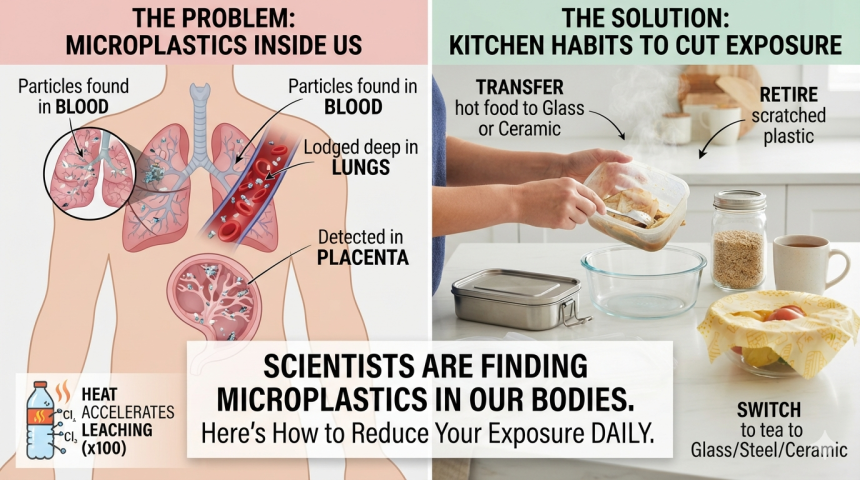
Scientists are finding microplastics in blood, lungs, and even the placenta. Here’s what that means — and the simple kitchen habits that can cut your exposure
Somewhere between your morning tea and tonight’s dinner, you’ve probably touched plastic dozens of times without thinking twice. That’s not an accusation — it’s just how modern life works. But a growing stack of research suggests plastic isn’t just touching us anymore. It’s inside us. In our bloodstream. In our lungs. Even, disturbingly, in the placenta protecting an unborn child.
This isn’t a distant environmental worry about turtles and ocean garbage patches — although that crisis is very real too. It’s a public health story unfolding in real time, in kitchens, in commutes, in the water bottle sitting in your car right now.
The particles too small to see, too big to ignore
Plastic doesn’t vanish when it’s thrown away — it just gets smaller. Left to sunlight and friction, it eventually breaks into fragments under 5 millimeters across, known as microplastics. These pieces are small enough to slip past the body’s usual defenses entirely unnoticed.
In 2022, a team of Dutch researchers published a study in Environment International that made headlines around the world: microplastics — PET, the same plastic used in water bottles, among them — turned up in the blood of roughly 80 percent of the healthy adults they tested. Around the same time, researchers at the UK’s Hull York Medical School reported finding plastic particles lodged deep in lung tissue removed during surgery, published in Science of the Total Environment. Perhaps most sobering, studies from 2021 found microplastics in the human placenta — the organ specifically built to shield a developing fetus from outside harm.
Taken together, these findings paint an uncomfortable picture: there may be no truly “unexposed” population left to compare against.
It’s not just physical particles — it’s chemistry, too
Plastic doesn’t need to break down at all to cause problems. The chemicals used to make it flexible and durable — Bisphenol-A (BPA) and phthalates chief among them — are increasingly being classified by researchers as endocrine-disrupting chemicals, or EDCs. Both the Endocrine Society and the environmental health group IPEN have flagged these compounds in joint reporting for their ability to mimic the body’s natural hormones, essentially sending the endocrine system false signals it can’t easily tell apart from the real thing.
The US National Institute of Environmental Health Sciences (NIEHS) links this chemical mimicry to a troubling list of effects: declining sperm quality in men, disrupted egg development and higher miscarriage risk in women, and thyroid dysfunction.
And there’s a well-documented “cancer” chapter to this story too. The International Agency for Research on Cancer — the WHO’s cancer research arm — has classified substances like styrene and vinyl chloride, both used in plastics manufacturing, as carcinogens. Long-term accumulation of these compounds, researchers warn, can damage cellular DNA in ways linked to breast and prostate cancers.
The kitchen habit that’s quietly making things worse
Here’s the part of this story that’s easiest to fix, and most people don’t know about it: heat dramatically accelerates how much plastic leaches into food.
The process is called chemical leaching — plastic polymers breaking down and migrating into whatever they’re touching as temperature rises. Research published in Food Additives & Contaminants found that microwaving plastic containers, or pouring hot liquids like tea or freshly cooked rice directly into plastic, can increase the rate of chemical release by roughly 100 times compared to room-temperature contact.
That “microwave safe” label on your plastic container? It’s a bit of a trap. It means the container won’t physically melt in the microwave — it says nothing about whether it’s releasing chemicals into your food while it’s in there.
A global economy built on a material we can’t quite quit
Zoom out, and it’s easy to see why plastic became inescapable in the first place. It’s lighter than glass, iron, or wood, which slashes transportation fuel costs in global trade. It vacuum-packs fresh produce and meat well enough to prevent spoilage across international shipping routes, easing food scarcity in places that would otherwise struggle to import perishables. And the production, packaging, and recycling industries built around it employ millions of people worldwide, particularly in developing economies where informal recycling has become a major livelihood.
But the ledger doesn’t balance. An estimated 11 to 14 million tons of plastic waste enters the world’s oceans every year, according to joint assessments from the UN Environment Programme and The Ocean Cleanup. The result is the Great Pacific Garbage Patch — a drifting accumulation of ocean plastic between California and Hawaii that, per research in Scientific Reports, spans roughly 1.6 million square kilometers. That’s nearly three times the size of France. The International Union for Conservation of Nature has linked this pollution to the near-extinction of hundreds of marine species that die from ingesting plastic or becoming entangled in it.
There’s a climate angle too: plastic is a byproduct of crude oil, and its production and incineration release greenhouse gases equivalent to roughly 189 coal-fired power plants annually — a climate cost that runs directly counter to the goals of the Paris Agreement.
And then there’s a quieter injustice: wealthy nations often export their plastic waste to Southeast Asian and African countries under the banner of “recycling.” Reports from Greenpeace East Asia and the Basel Action Network describe how countries like Malaysia, Vietnam, and Ghana accept this waste for payment, but — lacking the infrastructure to process it properly — often end up burning it instead, contaminating local groundwater and driving up respiratory illness in nearby communities, according to World Bank findings.
What you can actually do about it
The good news buried in all of this: your personal exposure is largely something you can control, without spending much money.
- Swap plastic storage for glass, steel, or ceramic. Pulses, spices, leftovers, pickles, and curd — especially acidic foods, which accelerate leaching — do best in glass jars, steel tins, or traditional clay pots.
- Never heat food in plastic, even containers labeled “microwave safe.” Transfer to glass or ceramic before heating.
- Let hot food cool before it touches plastic at all. Pouring hot tea, sambar, or rice straight into a plastic container is one of the fastest ways to introduce leached chemicals into your meal.
- Retire scratched or worn plastic containers immediately — surface damage makes it far easier for microplastic particles to shed directly into food.
- Ditch plastic water bottles, especially ones left in direct sun or inside a hot car — heat exposure compounds the leaching problem.
- Try beeswax wraps instead of cling film, and cotton mesh bags instead of plastic produce bags in the fridge — both are reusable and chemical-free.
None of this requires a lifestyle overhaul. It requires the same instinct that got humanity through millennia before plastic existed at all: steel, glass, and clay — materials that don’t quietly dissolve into what we eat.
The bigger picture
Plastic was, by nearly every economic measure, a brilliant invention — lightweight, durable, and central to global trade and food security. That’s precisely why undoing our dependence on it is so difficult. But the mounting evidence of it in human blood, lungs, and placental tissue suggests the bill for that convenience is coming due, and it’s being paid in body burden as much as in ocean debris.
Global measures like a binding UN Plastic Treaty may eventually address the production side of this crisis. Until then, the fastest lever anyone has is the one in their own kitchen.