


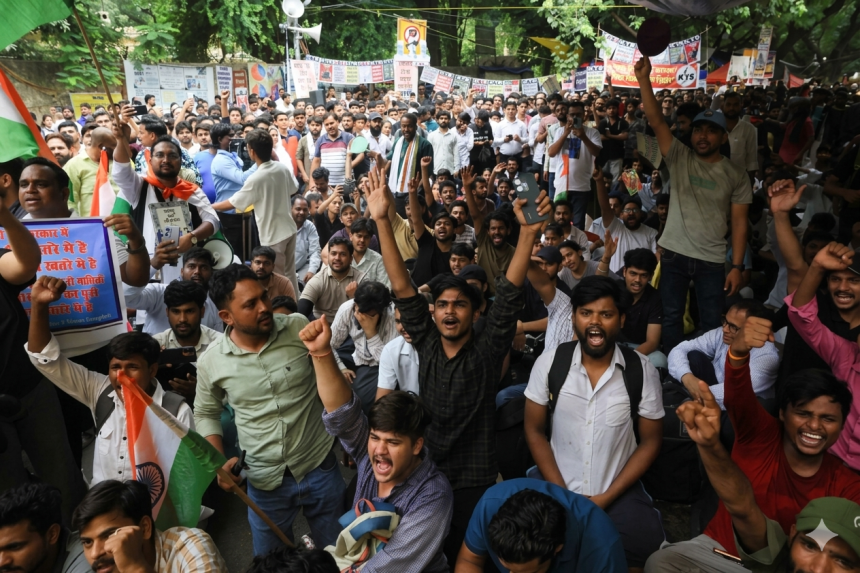
Thousands defy a police ban to march on Parliament, hours after a hunger-striking activist was hospitalized against his supporters’ wishes
New Delhi’s Jantar Mantar has seen its share of protests over the decades. But few have arrived with a name quite like this one — and few have grown quite this fast.
On Monday, thousands of supporters of India’s youth-led “Cockroach” movement gathered at the barricaded protest site in the heart of the capital, attempting to march on Parliament despite police explicitly denying permission for the demonstration. Security forces surrounded the site in large numbers, and by the time the crowd began pushing forward, some protesters were struck with police canes — turning what organizers had hoped would be a peaceful show of force into a visible confrontation just kilometers from the seat of India’s government.
From insult to movement in a matter of days
The strange name traces back to a moment in court. Back in May, India’s Supreme Court Chief Justice Surya Kant reportedly compared some unemployed young people to “cockroaches” during a hearing on an unrelated matter. Rather than take offense, a group of students and young professionals reclaimed the word, launching the Cockroach Janta Party (CJP) as a satirical banner for their frustration — and it caught fire. The party’s social channels reportedly gained more than 20 million Instagram followers within days of launching.
What the movement is actually angry about is more serious than its name suggests. The CJP’s core grievance traces back to alleged leaks of national medical entrance exam papers in May, which forced more than two million students to retake the test. Organizers are demanding the resignation of Education Minister Dharmendra Pradhan, sweeping reform of India’s examination system, and compensation for the families of students who died by suicide amid the fallout from the leaks and subsequent exam results.
A hunger strike, a hospitalization, and an escalation
The movement’s most galvanizing moment came not from the streets, but from a hospital bed.
Sonam Wangchuk, the 59-year-old engineer and education reformer known for his prior activism around Ladakh’s statehood, joined the CJP’s sit-in in late June and began an indefinite hunger strike on June 28. By the time authorities intervened this past Saturday, doctors monitoring him had reportedly recorded a weight loss of close to 9.5 kilograms, with his blood pressure and blood sugar under close watch.
Delhi Police say Wangchuk was moved to Safdarjung Hospital in accordance with a Delhi High Court order and medical advice, after a brief scuffle broke out when some protesters tried to stop the transfer. A police spokesperson described the move as a necessary medical intervention carried out under supervision. Hospital officials later said Wangchuk was conscious and stable, though he was reportedly refusing treatment and oral fluids.
The Cockroach Party’s leadership disputes the official account. A party spokesperson said no doctor had actually examined Wangchuk immediately before he was taken, and questioned whether the court had in fact ordered a forcible removal at all. On social media, the party described the move bluntly as an abduction carried out without Wangchuk’s or his family’s consent.
Whatever the full truth of that dispute — which remains contested and unresolved — the political effect was immediate. CJP founder Abhijeet Dipke told supporters that the group’s demands had escalated: it was no longer just Minister Pradhan’s resignation being sought, but Prime Minister Narendra Modi’s as well.
“Quit, quit”: the march that authorities didn’t want to happen
By Monday morning, on the opening day of Parliament’s monsoon session, thousands of supporters had arrived through the night to Jantar Mantar — students, working professionals, and even families with young children carrying backpacks stocked with food and water for what they expected to be a long standoff.
Protesters chanted for both Pradhan and Modi to resign, waving phone flashlights and Indian flags as police and paramilitary units held a heavily barricaded perimeter a few kilometers from Parliament itself. When demonstrators pushed to advance despite the denied permit, police used canes to hold the line — a scene that quickly spread across Indian and international news coverage.
Delhi’s deputy commissioner of police said talks had been held with CJP representatives, but no agreement had been reached on how, or whether, the march would be allowed to proceed.
Why this matters beyond one protest
Political analysts and international outlets have described the movement as the most significant public challenge to Modi’s government since he began his third term. What began as a niche, meme-fueled reaction to a courtroom jab has, in a matter of months, evolved into a nationwide conversation about exam integrity, student welfare, and — increasingly — accountability at the highest levels of government.
It’s also drawn political reactions well beyond the protest site itself, with opposition figures weighing in on the government’s handling of Wangchuk’s hospitalization, even as officials maintain their actions were guided strictly by medical necessity and court direction.
For now, the standoff at Jantar Mantar remains unresolved. Whether the march ultimately reaches Parliament, and whether Wangchuk’s health crisis becomes a turning point or a footnote, will likely shape how this movement — cockroach nickname and all — is remembered in Indian political history.
This report draws on coverage from multiple wire services and regional outlets tracking the Cockroach Janta Party protests in New Delhi. Details regarding Sonam Wangchuk’s hospitalization remain disputed between police and movement organizers; both accounts are presented here as reported.