

A decades-old political wound reopens as PDP chief invokes Sheikh Abdullah’s 1975 compromise to attack the sitting Chief Minister’s statehood push — turning a Delhi protest into a fight over Kashmir’s political soul
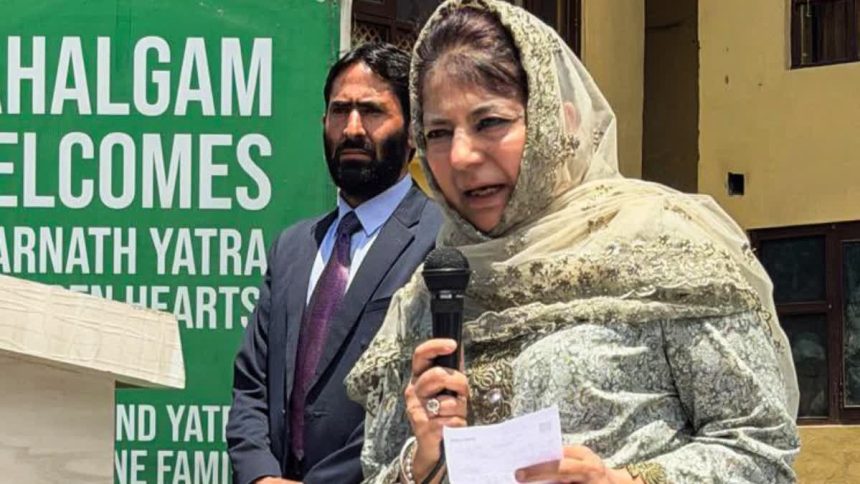
A political rivalry that traces back generations resurfaced with full force on Wednesday, as PDP president Mehbooba Mufti accused Jammu and Kashmir Chief Minister Omar Abdullah of repeating what she called his own grandfather’s historic capitulation — reducing a movement for Kashmir’s special status into a much smaller ask for statehood.
The Accusation: A Mandate Betrayed
Mufti’s central charge is that Omar Abdullah is quietly downgrading the National Conference’s own election promise. She pointed out that Kashmir’s voters handed the NC a sweeping mandate in the 2024 assembly elections — 50 MLAs, three Lok Sabha MPs, and three Rajya Sabha seats — specifically on the promise of restoring Articles 370 and 35A, the constitutional provisions that gave Jammu and Kashmir special status before their revocation in August 2019.
By campaigning instead for statehood alone, Mufti argued, Abdullah is instilling what she called a sense of defeat in the people he was elected to represent — effectively shrinking the Kashmir issue down to a lesser demand than what voters actually backed him for.
Invoking a Fifty-Year-Old Wound
To make her point, Mufti reached back to one of the most consequential — and controversial — moments in Kashmir’s political history: the 1975 Indira-Sheikh Accord.
That agreement, signed between G. Parthasarathy and Mirza Afzal Beg on behalf of Prime Minister Indira Gandhi and NC founder Sheikh Abdullah, ended Sheikh Abdullah’s 22 years of on-and-off incarceration and returned him to power — but only as Chief Minister, not the more sovereign-sounding “Prime Minister” and “Sadr-i-Riyasat” (President) titles Kashmir’s leadership had originally held before those posts were renamed Governor and Chief Minister in 1965.
Mufti’s argument is that Omar Abdullah is now walking the same path his grandfather once did — accepting a diminished political settlement (statehood) in place of the larger constitutional fight (Article 370 restoration) that the moment actually demands.
“Demanding statehood without special status while protesting at Jantar Mantar and every other place he is going… is normalisation of the post-August 5, 2019 situation,” Mufti said, adding pointedly that even the BJP is comfortable with a statehood-only demand — implying that Abdullah’s position offers little real challenge to the status quo Delhi has already established.
A Rivalry With Deep Roots
This isn’t a new fight — it’s the latest round of a long-running feud between Kashmir’s two major political dynasties. The clash was reignited a day earlier when Omar Abdullah accused the PDP of derailing Kashmir’s autonomy movement in the first place, tracing the split back to 1998, when the late Mufti Muhammad Sayeed founded the PDP with a rival “self-rule” slogan — and later cemented the rift by taking the PDP into a coalition government with the BJP in 2014.
Mufti’s response Wednesday was essentially a rebuttal delivered with historical force: rather than PDP undermining the movement, she suggested it’s NC’s own founding family that has a track record of settling for less when the moment called for more.
A Surprising Point of Common Ground
Despite the sharp criticism of Abdullah, Mufti struck a notably different tone when addressing the student-led protests currently gripped in Delhi over the NEET issue — expressing clear support for the young demonstrators at Jantar Mantar.
She described Gen Z as writing “a new movement… by its blood and sweat,” crediting the youth with reviving constitutional values that established political leaders, herself included, had failed to protect. It’s a notable pivot: even while attacking a fellow Kashmiri leader, Mufti aligned herself with the broader anti-government protest energy currently dominating national headlines.
Why This Matters Beyond Kashmir
On the surface, this is an intra-regional political spat between two familiar rivals. But it lands at a genuinely sensitive moment — Jammu and Kashmir remains a Union Territory more than six years after the abrogation of Article 370, statehood restoration remains an unfulfilled promise from the Centre, and any perceived softening of demands by the region’s main elected party carries real political weight for how Kashmir’s future status gets negotiated.
Mufti’s message, stripped to its essence, is a warning to her own political rival: don’t let today’s protest become tomorrow’s historical footnote of Kashmir settling for less than what its people were promised.