


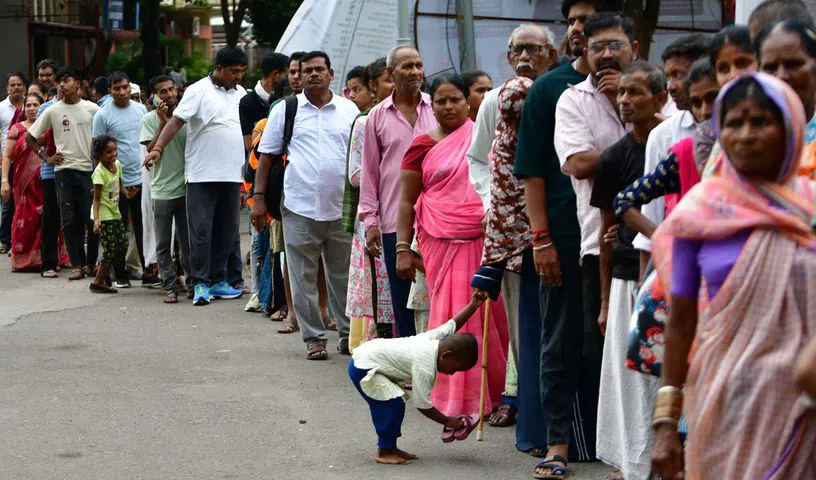
A secret herbal paste, a live murrel fingerling, and faith that has outlasted generations — Hyderabad’s most extraordinary annual tradition is back today at Exhibition Grounds.
At exactly 9 pm tonight, a queue stretching hundreds of metres at Hyderabad’s Nampally Exhibition Grounds will inch forward — and one by one, thousands of people will open their mouths to receive something that no pharmacy can sell them. A live fish, barely three centimetres long, stuffed with a yellow herbal paste whose recipe has never been written down, never been patented, and never left the custody of a single Hyderabad family in over 180 years. They will swallow it whole. Some will have travelled for days to be here. Many will come back again next year, and the year after that.
Welcome to the Bathini fish prasadam — one of India’s most remarkable, most debated, and most enduring folk medicine traditions. Today marks yet another edition of an event that began in 1845 and has not missed a single Mrigasira Karthi since.
The legend behind the ritual
On a stormy Mrigasira Karthi night in 1845, a wandering saint from the Himalayas knocked on the door of the Bathini family. In exchange for shelter and food, he is said to have passed on the secret formula for a herbal paste that could cure asthma and respiratory ailments — on one condition: it must always be given free of charge.
That condition has held for 181 years. Every rupee spent on the event — the fish, the logistics, the counters, the staff — comes from the Bathini family and government support. Not a single patient pays. It is, by any measure, a staggering act of sustained faith and generosity.
What actually happens
The process is as striking as it sounds. Members of the Bathini family stuff a tiny live murrel fish — a freshwater snakehead fingerling — with a yellow herbal paste whose exact ingredients remain a closely guarded family secret. The fish is then placed at the back of the patient’s throat and swallowed without water. For vegetarians, the herbal paste alone is administered with jaggery.
The process is repeated for three consecutive years, after which a full cure from asthma is claimed. Patients are also advised to follow a strict 45-day diet and lifestyle regimen after taking the prasadam — a set of guidelines provided exclusively by the Bathini family.
The city gears up
Thousands of people have already begun arriving from across Telangana, Andhra Pradesh, and other states — many having taken overnight buses or trains, some having made the journey on faith alone. The TGSRTC has deployed special buses from MGBS and key points across the city. NGOs have set up food and water stations that will run through the night. The Fisheries Department has kept 1.2 lakh murrel fish seed ready at the venue. Police have been deployed in strength across queue lines and distribution counters for crowd management.
“Fish prasadam will be offered free of cost, and we will ensure that every patient receives it,” a Bathini family spokesperson said.
Faith vs science — a debate as old as the ritual
The Bathini fish prasadam sits squarely at the intersection of tradition and scepticism. Scientists, rationalists, and health experts have repeatedly questioned whether the remedy has any measurable clinical effect on asthma. No peer-reviewed study has validated the cure. The exact herbal ingredients have never been disclosed for independent analysis. The Indian Medical Association has, in past years, urged caution.
And yet — patients return. Some report relief lasting months. Some say three years of the prasadam changed their lives. The sheer scale of belief, sustained across nearly two centuries and multiple generations of a single family, is itself a phenomenon that science has struggled to adequately explain or dismiss.
Note: The medicinal claims of the Bathini fish prasadam have not been scientifically validated. Medical experts advise asthma patients to consult a qualified physician and not discontinue prescribed medication in favour of folk remedies.
What is beyond dispute is this: in a city that moves at the speed of IT campuses and startup corridors, one family has kept a monsoon-season promise made in 1845 — free of charge, without fail, for 181 consecutive years. Whatever one thinks of the remedy, the ritual is extraordinary.