


AI, virtual reality, and robotic navigation are rewriting the rules of brain tumour surgery — and Hyderabad’s neurosurgeons say the city is at the leading edge of this transformation.
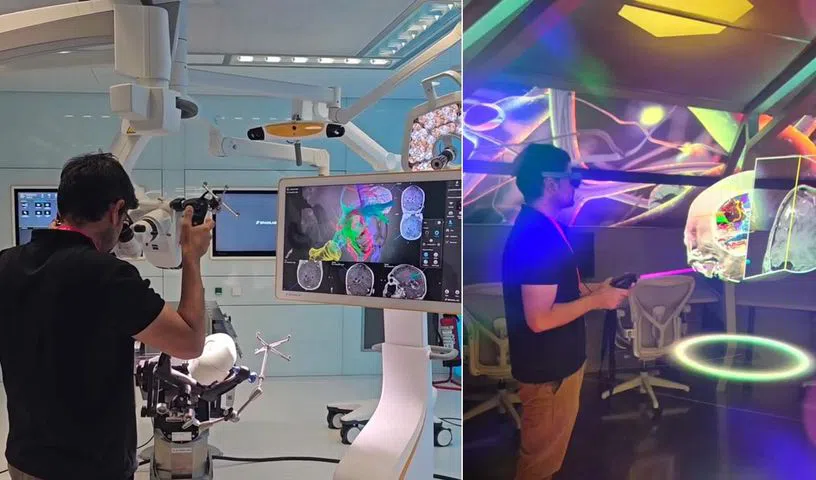
Before a single incision is made, before the patient is even wheeled into the operating theatre, the surgeon has already been inside the brain. Using a VR headset, they have walked through a high-definition, colour-coded, three-dimensional reconstruction of the patient’s own neural architecture — mapping the tumour’s exact boundaries, tracing critical pathways for speech, memory, and movement, and planning the safest possible surgical route. By the time they pick up the scalpel, there are no surprises.
This is what brain tumour surgery looks like in Hyderabad in 2026. On World Brain Tumour Day, observed on June 8, senior neurosurgeons in the city declared something that would have seemed like science fiction a decade ago: a brain tumour diagnosis no longer needs to mean the loss of who you are.
The technology stack changing neurosurgery
The transformation is not driven by a single invention but by a stack of technologies working in concert — each one addressing a different limitation of traditional neurosurgery.
Virtual Reality Brain Mapping: Surgeons step inside 3D reconstructions of the patient’s brain before surgery, tracing neural pathways and planning incision routes with zero risk to the patient.
Robotic Navigation Systems: In the operating room, robotic systems cross-reference live anatomy with the pre-surgical 3D model in real time, correcting for millimetre-level shifts during the procedure.
Connectomics-Guided Mapping: AI analyses millions of neural data points from a standard MRI to build a personalised brain network map — revealing connections invisible to conventional imaging.
Laser-Assisted Precision: Targeted laser systems ablate tumour tissue with sub-millimetre accuracy, reducing collateral damage to healthy brain matter surrounding the tumour.
The surgeon who goes in through the eye socket
Perhaps the most striking advance highlighted on Sunday was the endoscopic transorbital approach — a technique in which surgeons reach selected brain tumours through natural anatomical corridors such as the eye socket, entirely avoiding the need to cut through the skull in the conventional sense. The result: a dramatically smaller surgical footprint, faster recovery, and reduced risk to the surrounding brain tissue.
“Advanced endoscopic transorbital and endoscopic skull base approaches allow surgeons to reach selected tumours through natural anatomical corridors, often minimising or avoiding manipulation of normal brain tissue entirely,” said Dr Abhirama Chandra Gabbita, senior neurosurgeon and neuro-oncology and skull base specialist, Hyderabad.
What this means for the patient
The practical impact on patients is profound. The central fear with brain tumour surgery has always been this: even if the tumour is removed, what if the surgery takes something else with it — the ability to speak, to remember, to move a hand? These are not abstract risks. They are the reason many patients have historically declined surgery altogether.
The new generation of tools directly addresses each of these fears. Connectomics-guided mapping allows surgeons to identify and preserve not just the anatomical location of speech or motor function, but the actual network connections that enable those functions — connections that vary significantly from patient to patient and are often displaced by tumour growth.
“A combination of early detection and advanced treatment definitely leads to better outcomes,” Dr Gabbita added. “These minimally invasive techniques can reduce the surgical footprint on the brain, improve outcomes, shorten recovery times and enhance the safety of tumour removal in carefully selected patients.”
Hyderabad at the frontier
What makes today’s announcement significant is its geography. These technologies — VR pre-surgical planning, robotic intraoperative navigation, connectomics-guided mapping, endoscopic skull base approaches — are being actively deployed in Hyderabad hospitals, not just discussed in international journals. The city’s neurosurgical community is not observing this revolution from a distance. It is participating in it.
For the roughly 5 to 10 in every 100,000 Indians who will receive a brain tumour diagnosis this year, that proximity matters enormously. The best brain tumour surgery in the world is increasingly available not just at institutions in London or New York — but here, in Hyderabad, today.