


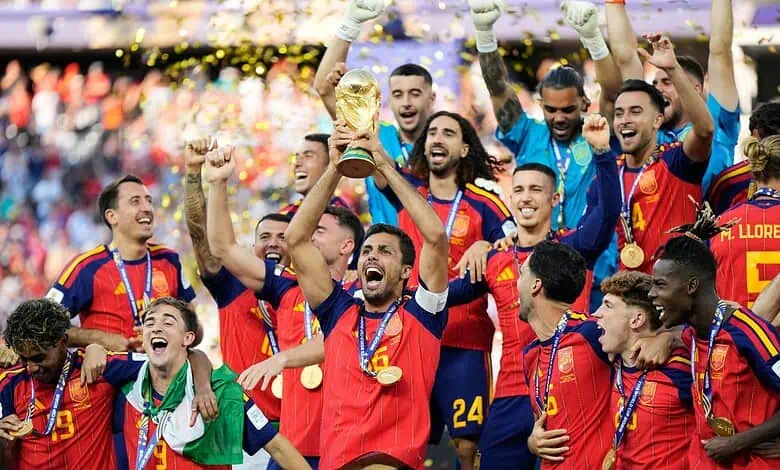
In the 2026 FIFA World Cup final, Spain did something few teams have managed: they made Lionel Messi look mortal. Through a disciplined, collective tactical plan, La Roja restricted the 39-year-old Argentine captain to minimal impact, helping secure a 1-0 extra-time victory and their first World Cup title in 16 years.
A plan built on control, not man-marking
Spain’s approach was not about assigning one defender to follow Messi everywhere. Instead, coach Luis de la Fuente’s side focused on controlling the spaces where Messi usually operates and cutting off the supply lines from Argentina’s midfield.
The strategy began in the centre of the park. Rodri acted as a spatial guard in the half-spaces Messi favours, blocking passing lanes from Argentina’s midfielders. When Messi drifted wide to escape, full-back Marc Cucurella stepped up aggressively, often with a centre-back providing cover, forcing him backwards or trapping him along the touchline.
Coordinated pressing and compact shape
Spain used coordinated, cue-based pressing rather than constant chasing. They waited for triggers such as a poor touch, a backward pass or an Argentine player receiving with his back to goal, then moved together to close down options. This prevented Argentina from creating the quick combinations through which Messi usually escapes pressure.
Defensively, Spain stayed compact. When out of possession, Cucurella tucked inside to form a back three, narrowing the channels and forcing Argentina into wider, less dangerous crossing positions. The high line was protected by aggressive counter-pressing from wingers and forwards, winning the ball high and starving Messi of possession in advanced areas.
The result: Messi silenced
The impact was clear in the numbers. Messi was restricted to just one shot in the match and had a career-low number of touches in a World Cup final, often isolated for long periods with little support around him. Spain’s midfield consistently outplayed Argentina’s, leaving the Argentine captain disconnected from the game’s rhythm.
Spain understood that completely removing Messi from the match was unrealistic. Their real aim was to decide where he received the ball and ensure those areas were not dangerous. By controlling the tempo, compressing the pitch and pressing intelligently, they turned Messi’s usual magic into moments of frustration.
A tactical masterclass
The final will be remembered as a tactical masterclass from Spain. They reversed the usual equation: instead of Argentina dictating play through Messi, Spain dictated where Messi could play. The result was a World Cup-winning performance that combined discipline, spatial control and collective defending to curb one of the greatest players in football history.