

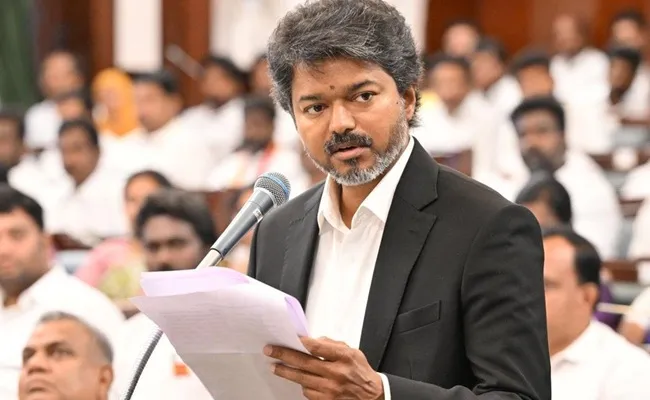
Vijay walked into the Chief Minister’s office with zero governance experience and maximum scepticism around him. Thirty days later, he is doing something most politicians take years to learn: listening.
Let us be honest about what everyone was thinking when Vijay was sworn in as Tamil Nadu’s Chief Minister exactly one month ago.
A superstar. A man whose fans worship him in temples. A person who had never once sat in a government office, navigated a bureaucratic file or handled a state budget. The question on every political analyst’s lips was not whether he would succeed — it was how quickly, and how badly, he would stumble.
One month in, the stumbling has not happened. And Tamil Nadu is quietly, cautiously impressed.
The First Thing He Got Right
In Indian politics, power has a way of expressing itself through architecture. Chief Ministers build walls. They hire gatekeepers. They cultivate inner circles that decide who gets access and who gets left outside in a plastic chair. These invisible structures — the parallel power centres that every government eventually develops — are often where governance goes to die.
One of the most striking features of Vijay’s administration has been the complete absence of any parallel power centre. He remains firmly in command, with no closed coterie acting as a barrier between the Chief Minister and MLAs, MPs or party workers. His accessibility and direct engagement with elected representatives have strengthened confidence within both the party and the government.
For a man entering politics from film, where access is everything and distance creates aura, choosing radical accessibility as his governing style is a deliberate and significant choice.
The Decisions That Made People Notice
Good intentions are common in politics. Decisions that actually cost something — that prioritise people over convenience, or principle over revenue — are considerably rarer.
In one of his most significant early decisions, Vijay ordered the closure of 717 TASMAC liquor outlets located near schools, places of worship and bus stands — addressing a long-standing public demand and drawing immediate praise from community groups and families across the state.
Seven hundred and seventeen outlets. Not a token closure. Not a symbolic gesture. A decision that directly impacts state revenue, draws the ire of powerful commercial interests, and visibly improves the daily lives of families in thousands of neighbourhoods across Tamil Nadu.
Beyond this, the government increased the free electricity quota for eligible households to 200 units per month, initiated the revival of Amma Unavagam canteens across the state, launched the Singappen Special Force for women’s safety and strengthened anti-drug enforcement near educational institutions. Measures such as capping private school fees and taking action against belt shops have been welcomed by many sections of society.
In thirty days, that is a governing agenda that most politicians spend an entire term promising and never delivering.
The Vision Document Nobody Expected
Vijay also unveiled the ambitious “Vetri Tamizhagam” vision document containing hundreds of development initiatives, while emphasising administrative discipline and transparency in governance.
Vetri Tamizhagam — Victorious Tamil Nadu. The title alone is a political statement: this government arrived not to manage the present, but to transform it. Whether the document translates into reality over a full term is the question that political analysts are reserving judgment on. But the fact that it exists — detailed, structured and publicly presented within the first month — signals an administrative seriousness that many doubted Vijay possessed.
The Real Test Is Just Beginning
One month is, of course, exactly long enough to look good and not nearly long enough to govern. The budget cycle, coalition tensions, drought or flood management, land disputes, industrial conflicts — the full weight of running a state with 78 million people has not yet arrived at Vijay’s door in all its complexity.
The bureaucracy — that vast, slow, self-protective organism that outlasts every government — has not yet been truly tested by his administration. The opposition, still reeling from its electoral defeat, has not yet mounted the kind of sustained, organised attack that will come when the honeymoon ends.
But here is what the first month has established with genuine clarity: Vijay is not pretending. He is not holding press conferences while officials run the show behind him. He is not surrounding himself with advisers who filter out the difficulty of governing. He is, by all available evidence, actually doing this.
Tamil Nadu gave a superstar its highest office. One month in, the superstar appears to be giving Tamil Nadu a chief minister.