


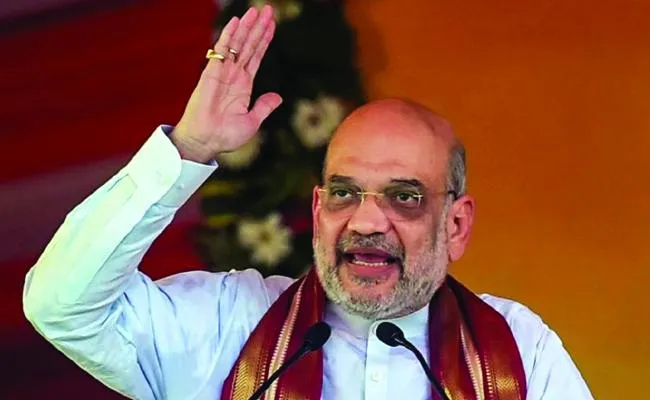
The Home Minister casually told reporters that BJP will go alone in Telangana. He said nothing about Andhra Pradesh. That silence is the loudest thing said in Telugu politics this week.
In politics, what is not said is often more important than what is.
On Wednesday, Union Home Minister Amit Shah sat down with reporters in New Delhi to mark 12 years of Modi’s government. It was supposed to be a celebration — a victory lap, a showcase of achievements, a moment of confident reflection.
Instead, Shah said something that has set two Telugu states buzzing with anxiety, speculation and barely concealed alarm.
“Our goal is to contest alone and come to power in every state where elections are held, whether it is Punjab or Telangana,” Shah said. “We will contest there alone.”
Clear. Direct. Unambiguous — about Telangana.
But then a reporter asked the obvious follow-up question. What about Andhra Pradesh — where BJP’s coalition partner Chandrababu Naidu runs the government, where the NDA alliance delivered a historic 164-seat victory in 2024, where TDP and BJP have governed together as partners?
Shah did not make the BJP’s future strategy in neighbouring Andhra Pradesh clear. He said all regional parties in the NDA alliance were doing well. “We are not causing any problems to any regional party associated with us. Everyone, including Nitish Kumar, Chandrababu Naidu and Shinde, is satisfied,” he said.
He named Naidu. He said he was satisfied. And he said absolutely nothing about whether BJP would stay allied with TDP in the next election.
In political language, that is not reassurance. That is a warning dressed in polite clothing.
The Telangana Declaration and What It Actually Means
To understand why Shah’s Telangana statement matters so much, you need to understand where BJP currently stands in that state.
In the 2023 Telangana elections, BJP won exactly eight seats out of 119. Eight. In a state it has been trying to crack for over a decade, against a Congress government that is itself struggling with governance challenges, BJP’s footprint is barely visible.
Shah emphasised that the BJP’s ultimate objective is to expand independently across the country and form governments on its own, rather than depend on coalition arrangements. According to Shah, the BJP has placed special focus on southern India as part of its expansion strategy. He said the party would invest heavily in building organisational strength across southern states and increasing its electoral footprint.
Ambition is not strategy. But when Amit Shah announces ambition, it is usually followed by a plan. And plans in BJP’s southern expansion strategy have a habit of making current allies very uncomfortable.
The Question Every TDP Leader Is Asking Today
Here is the political reality that Shah’s remarks have cracked open like a fault line.
This has given rise to speculation that, if not immediately, the BJP may dump the TDP in the coming years and go alone in Andhra Pradesh as well.
For Chandrababu Naidu, this is not an abstract threat. His entire second comeback — the sweeping 2024 victory, the return to Amaravati, the investor summits and Sunrise Andhra Pradesh narrative — was built partly on the credibility and resources that the BJP alliance brought to the table. Modi’s face on TDP campaign posters was not decoration. It was electoral currency.
If BJP decides that Andhra Pradesh is next on its “go alone” list, Naidu faces a governing partner that is simultaneously becoming a rival. He would have to manage a state government while also preparing to fight a national party that currently sits inside his cabinet.
It is the kind of political situation that keeps chief ministers awake at three in the morning.
Shah’s Reassurance That Reassures Nobody
Shah appeared to indicate that the BJP had already achieved unexpected success in regions such as West Bengal and that securing power independently in southern states should not be considered an impossible goal.
West Bengal. The state where BJP went from 3 seats to 77 seats between 2016 and 2021 — entirely through solo effort, entirely by building from scratch, entirely by treating a regional party first as an ally and then as a target.
The parallel is uncomfortable enough that you wonder if Shah chose it deliberately.
Analysts believe the comments represent one of the clearest indications yet of the BJP leadership’s long-term ambition to emerge as a major standalone political force across southern India, rather than functioning primarily through partnerships with regional parties.
What Happens Next
The 2029 Andhra Pradesh elections are three years away. That is a long time in Indian politics — long enough for alliances to deepen, or to quietly unravel.
For now, TDP and BJP remain partners. Naidu is officially “satisfied.” The NDA in Andhra Pradesh is publicly intact.
But Amit Shah just told the country — and told Chandrababu Naidu very specifically — that BJP’s long-term vision does not include permanent dependence on regional allies anywhere in India.
The message to Naidu is simple, if uncomfortable: enjoy the alliance while it lasts. Because in BJP’s India, every partner is eventually a stepping stone.
The question is not whether BJP will come for Andhra Pradesh. The question is when — and whether Naidu will see it coming in time to do something about it.