


In a modest office in Hyderabad, a small team just did something that usually takes a national defence lab and a blank cheque. This is the story of the Yantur engine — and the bet that built it.
There’s a reason turbofan engines are considered the final boss of aerospace engineering. Airframes can be shaped by ambitious engineers with good CAD software and a wind tunnel. Avionics can be written by sharp coders with enough patience. But the engine — the screaming, spinning heart of anything that flies — punishes shortcuts. It runs hot enough to soften metal, spins fast enough to tear itself apart if a single blade is a fraction of a millimetre off, and forgives almost nothing.
That’s exactly why, for decades, only a short list of nations and a handful of state-run giants have ever built one from scratch. Everyone else buys the engine and builds around it.
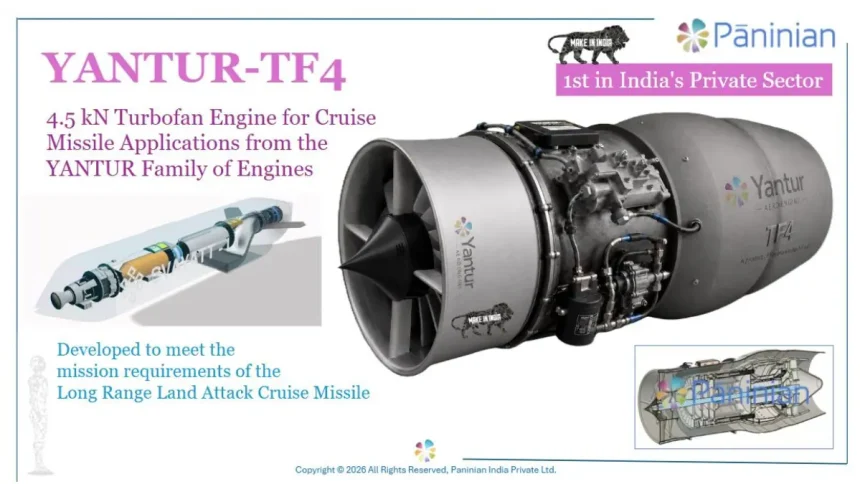
Which is what makes this week’s announcement out of Hyderabad worth pausing on. A private company — not a national lab, not a decades-old public-sector behemoth — says it has designed a working turbofan engine core entirely in-house. Its name is Yantur. And it isn’t destined for an airliner. It’s built to fly inside a cruise missile.
The unglamorous math of 4.5 kilonewtons
The Yantur’s official designation — 4.5 kN — sounds unremarkable next to the roaring numbers associated with fighter jet engines. But that’s the point. A cruise missile doesn’t need brute force; it needs discipline. It has to sip fuel efficiently over hundreds of kilometres, stay quiet enough to avoid easy detection, and keep running reliably through a single, uninterrupted mission with no room for a mid-flight fix.
Paninian India, the company behind Yantur, has designed the engine specifically for that job — powering the cruise phase of its SVAYATT-L1, a long-range land attack missile the company describes as built for precision strikes against heavily defended targets. The mission profile reads like something out of a technical thriller: a solid rocket booster does the violent work of launch, and once that’s done and falls away, the Yantur turbofan quietly takes over, carrying the missile low and level across the distance to its target.
A core built to grow up
Here’s the detail that separates Yantur from being just “a missile engine” — its architecture, according to Paninian, is scalable. The same fundamental core that powers a 4.5 kN cruise missile engine can, in theory, be stretched into more powerful variants down the line.
The company has its sights set on Collaborative Combat Aircraft — CCAV platforms, in defence-speak — a new generation of autonomous, uncrewed jets designed to fly in formation with human pilots, extending strike range and sensor coverage without risking more lives in the cockpit. It’s a category several major air forces are racing toward right now. And a country that can build its own scalable engine core for that future doesn’t have to wait in line behind a foreign supplier’s export approvals to get there.
That’s the quiet ambition tucked inside a modest thrust number: not just one missile engine, but potentially the first rung of an entire indigenous propulsion ladder.
“This milestone belongs to our young engineering team”
Behind the specifications is a company that, by aerospace standards, is still remarkably young. Announcing the milestone, Paninian India founder Raghu Adla framed it less as a corporate achievement and more as a statement of national capability — describing Yantur as a pioneering private-sector effort to build sovereign Indian propulsion capacity for the strategic autonomous systems of the future.
He was careful to give the credit somewhere specific: not to funding, not to government contracts, but to the people who actually did the work — his engineering team, advisors, and partners, who took what began as an ambitious idea and turned it into what he called a credible engineering programme.
It’s a small detail, but it says something about how this milestone actually happened. Sovereign propulsion capability doesn’t get built by press release. It gets built in a series of unglamorous, unphotographed days — compressor stage calculations, combustor geometry iterations, turbine blade simulations run and rerun — by a team most of India has never heard of, working out of a city more commonly associated with pharma exports and IT campuses than fighter-grade propulsion.
The hardest part is still ahead
To Paninian’s credit, nobody involved is pretending the job is finished. The Yantur programme has reached the detailed design phase — a genuine and hard-won milestone — but an engine that exists in simulation and on a design bench is not the same as one that has survived the brutal, repetitive punishment of real testing.
That’s why the company is now openly seeking help: access to multi-stage compressor and turbine test rigs, and to high-altitude test facilities that can simulate the thin, punishing air an engine encounters in actual flight. These are the kinds of specialized, expensive facilities that even well-funded national programmes queue up for. Paninian is asking government bodies, industry players, and investors to help it get there faster — a candid admission that reaching detailed design was the beginning of the hard part, not the end of it.
Why this story matters beyond one engine
Every country that has eventually built its own military aircraft engines went through this exact, unglamorous phase — design on paper, followed by years of grinding, expensive validation before anything is trusted to actually fly. What makes this particular chapter interesting is where it’s happening: not inside a state-owned aerospace behemoth with a decades-long mandate and a guaranteed budget, but inside a private company betting its own survival on getting this right.
If Yantur clears the testing gauntlet ahead of it, it won’t just be a missile engine. It will be proof that India’s next generation of strategic propulsion technology doesn’t have to come exclusively from the institutions that have always built it — it can come from a small, determined team in Hyderabad, willing to attempt the one part of aerospace engineering that punishes hesitation the most.