


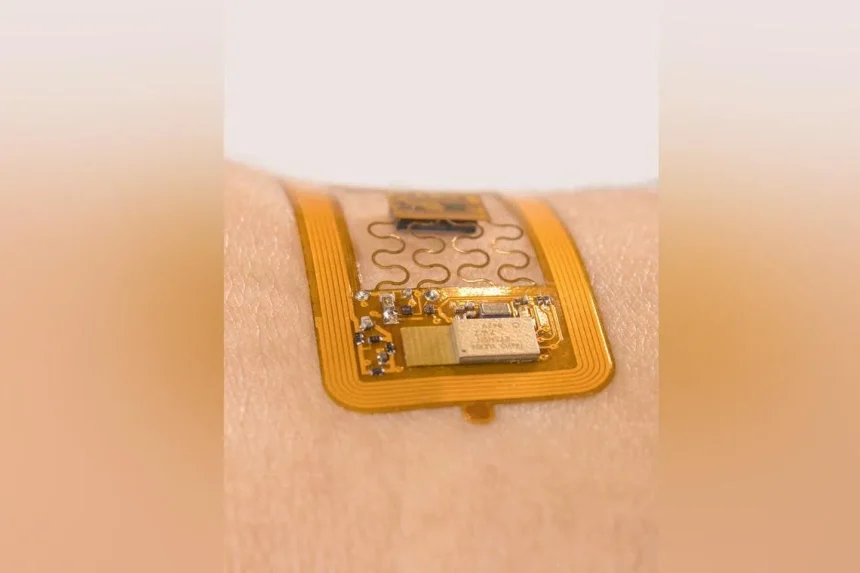
A groundbreaking skin patch developed by researchers at the National University of Singapore (NUS) could revolutionize how millions track their blood pressure, eliminating the need for bulky cuffs, frequent recharging, and painful interruptions in daily life.
The lightweight, battery-free prototype monitors blood pressure continuously throughout the day and night, offering round-the-clock cardiovascular tracking without the cumbersome equipment that has plagued blood pressure monitoring for decades.
The Problem with Traditional Blood Pressure Monitoring
For decades, blood pressure measurement has been stuck in the past. The standard method involves wrapping a bulky cuff around your arm, squeezing it tight, and waiting painfully while it inflates. You must sit still, remain silent, and endure the discomfort — all while getting only a snapshot of your blood pressure at that exact moment.
“For people with hypertension or cardiovascular risks, this means missing critical data about how their blood pressure changes during sleep, exercise, work, or stress,” said the NUS research team. “Traditional cuffs can’t capture the full picture of cardiovascular health.”
Now, NUS researchers have developed a solution that could change everything.
How the Battery-Free Patch Works
The NUS skin patch uses two strategically placed sensors to continuously monitor blood pressure:
Sensor 1: Placed over the heart to detect electrical signals as blood is pumped out
Sensor 2: Positioned on the wrist to measure changes in blood volume
The device calculates the time it takes for blood to travel from the heart to the wrist, then uses this timing to infer blood pressure levels with high accuracy.
“To avoid interference from moving parts, the researchers removed all bulk, including batteries,” explained the team. “Instead, the sensors draw power wirelessly from a smartphone strapped to the user’s upper arm.”
The Revolutionary Power System
The most innovative aspect of the device is how it eliminates the battery problem entirely. Conductive fabric stitched into a long-sleeved shirt links the sensors to the smartphone, which supplies energy via near-field communication (NFC). Data is then transmitted back to the phone through Bluetooth.
This wireless power transfer means:
- No batteries to replace or recharge
- Lighter, more comfortable design
- Continuous monitoring without interruptions
- No need to remove the patch for charging
The system separates power transfer (13.56 MHz) and data communication (2.4 GHz) channels through a dual-mode metamaterial textile, providing efficient wireless power transfer and low-latency data communication.
Real-World Testing: Works During Exercise
The NUS team tested the battery-free epidermal network in real-world conditions, including during exercise and other dynamic environments. The network successfully monitored systolic blood pressure continuously, demonstrating that the device works accurately even when the user is moving.
“This is crucial because blood pressure changes dramatically during physical activity, stress, and sleep,” said Assistant Professor Tee, who led the research. “Traditional cuffs can’t capture these dynamic changes, but our patch does.”
What This Means for Hypertension Patients
For people with hypertension — which affects over 1 billion people worldwide — this technology could transform how they manage their condition. Continuous blood pressure monitoring would help doctors:
- Identify patterns in blood pressure fluctuations throughout the day
- Detect dangerous spikes during sleep or stress
- Adjust medication timing based on actual blood pressure trends
- Prevent cardiovascular events by catching problems early
- Personalize treatment based on real-time data
“Hypertension is often called the ‘silent killer’ because it shows no symptoms until it causes a stroke or heart attack,” the researchers noted. “Continuous monitoring could help catch dangerous blood pressure changes before they become life-threatening.”
The Future of Wearable Health Technology
The NUS skin patch represents a major leap forward in wearable cardiovascular monitoring. The technology could eventually be integrated into regular clothing, making health monitoring completely seamless and invisible.
“The long-term goal is to create a tiny smart patch that can predict cardiovascular health,” said the NUS team. “This battery-free sensor is a step forward toward that reality.”
Future versions might include:
- Machine learning algorithms to predict cardiovascular risks
- Additional sensors for heart rate, oxygen levels, and other vital signs
- Smartphone integration for real-time health alerts
- Cloud-based health monitoring for doctors to track patients remotely
Commercial Potential and Timeline
While the current prototype is still in development, the NUS researchers believe commercial versions could be available within the next three to five years. The technology addresses a critical gap in wearable health monitoring, where battery life has traditionally been a major limitation.
The research team has already published their findings in a peer-reviewed journal, demonstrating the scientific validity of their approach. Clinical trials are expected to begin soon to validate the device’s accuracy against traditional blood pressure monitoring methods.