

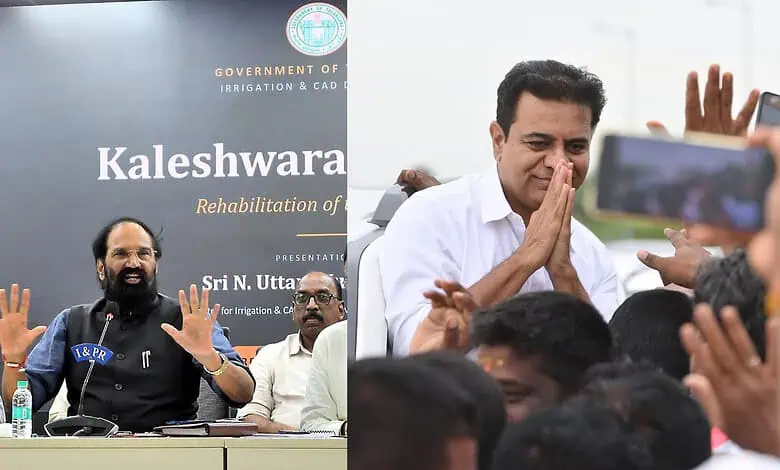
A four-hour drive turned into a nearly seven-hour political standoff on Sunday, as BRS working president KT Rama Rao pushed through police barricades across three districts to reach the Kannepalli pump house — only to be met, hours later, by a blunt rejection from the state’s Irrigation Minister: the pumps are not switching on anytime soon.
The dispute over Kannepalli, a key pump house in the Kaleshwaram Lift Irrigation Project, has become the latest flashpoint in Telangana’s long-running fight over the fate of the state’s most expensive — and most controversial — irrigation scheme.
A convoy, a siege threat, and a statue stop
Rama Rao left Hyderabad on Sunday morning with BRS leaders from the erstwhile Warangal, Karimnagar and Nalgonda districts, heading for the pump house in Jayashankar Bhupalpally district. He didn’t get there easily. Heavy police deployment and barricades on the Hyderabad–Warangal highway stopped his convoy at Pembarthi in Jangaon district, while preventive arrests and house detentions of BRS workers were reported across Jangaon, Station Ghanpur, Hanamkonda, Parkal and Wardhannapet. BRS cadres eventually lifted the toll barriers themselves, letting the convoy push on — with a brief detour for Rama Rao to garland a B.R. Ambedkar statue at Parkal — before it reached Kannepalli.
Addressing reporters at the pump house, Rama Rao alleged that nearly 98,000 cusecs of Godavari water were being allowed to flow wastefully into the sea despite sufficient water being available for lifting at Kannepalli. He argued the pump house didn’t need to wait on the damaged Medigadda barrage at all, claiming the river level was around 96 metres, while pumping was possible from 92 metres at Kannepalli. He went further, warning that if the government stayed silent, the BRS would mobilise 50,000 people and lay siege to the Kannepalli pump house to ensure the pumps are switched on.
The government’s answer: it’s not politics, it’s physics
Irrigation Minister N. Uttam Kumar Reddy wasted no time hitting back. At a press conference at the Secretariat the same day, he dismissed the BRS demand as dangerous and misleading, explaining that switching on the Kannepalli pumphouse will release water into the Annaram barrage, which is plagued with several defects in its foundation. He said the National Dam Safety Authority (NDSA) has advised against holding water in any barrages of the Kaleshwaram project until comprehensive repairs are completed.
Citing the NDSA’s findings, Reddy laid out a long list of structural red flags across the Medigadda, Annaram and Sundilla barrages — compromised cut-off walls, seepage and piping beneath the foundations, weak stilling basins and what he called quality-control failures dating back to construction. His framing was pointed and repeated for emphasis: “The pumps cannot be operated. The pumps can’t be operated.” He insisted the standoff wasn’t a political argument at all, but “engineering and public safety.”
A 2027 deadline — and an alternative in the works
According to the minister, rehabilitation work is underway with technical backing from the Central Water and Power Research Station in Pune and international consultants working alongside IIT Bombay, under NDSA and Central Water Commission oversight. He said testing was nearing completion and design finalisation will continue during the current monsoon, with construction to begin once flood waters recede and rehabilitation targeted for completion by July–August 2027. Until then, he said, the barrages will stay in free-flow mode — meaning no water storage, and no Kannepalli operation.
He also revealed the government isn’t just waiting on repairs: it’s pursuing the Tummidihatti project as a parallel solution, with a detailed project report already assigned and outreach underway with the Maharashtra government to make it work.
Old wounds, reopened
Reddy didn’t stop at engineering. He turned the dispute into a referendum on the previous BRS government’s handling of the ₹1.5-lakh-crore project, accusing it of substandard construction and serious foundation flaws driven by commercial motives rather than farmers’ welfare, and said letters had been sent to the Centre seeking a CBI probe — so far without response. He dismissed Rama Rao’s Kannepalli visit as theatrics, adding that had the previous government built the project properly, the Kannepalli pump could have been operational long ago.
Notably, T. Harish Rao — the BRS leader who ran the Irrigation Department for nearly a decade during Kaleshwaram’s construction — has stayed conspicuously quiet through the latest round, leaving Rama Rao to carry the political fight largely alone.
Why it matters
With Reddy’s own account acknowledging that El Niño could weaken this year’s southwest monsoon by as much as 35%, the underlying stakes are real: 26 of Telangana’s 33 districts are already reporting drought-like conditions, according to BRS’s numbers, even as monsoon flows swell the Godavari. Whether that tension gets resolved through the government’s phased, safety-first repair timeline or boils over into the mass mobilisation KTR has threatened will likely shape Telangana’s irrigation politics well into 2027.