


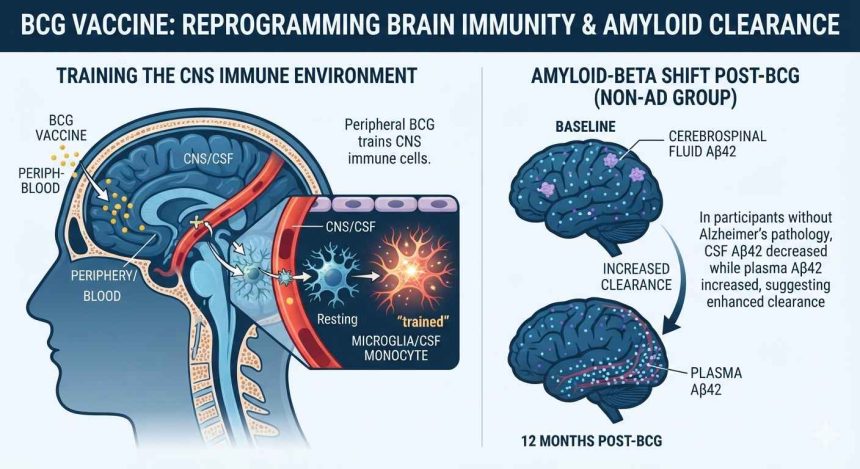
A small but rigorous clinical study out of Massachusetts General Hospital is the first to show that the BCG vaccine can “train” immune cells inside the human central nervous system — not just in the blood — and that the shift tracks with changes in Alzheimer’s-linked amyloid-beta.
For more than a century, Bacillus Calmette-Guérin (BCG) has been known mainly as a tuberculosis vaccine and, more recently, as a standard treatment for early-stage bladder cancer. But in the past decade, immunologists have discovered BCG does something stranger than simply teaching the body to recognize one pathogen: it seems to leave the entire innate immune system more alert, a phenomenon called trained immunity. People who get BCG appear to respond more robustly to unrelated infections for months or years afterward, and several retrospective studies have even linked bladder-cancer patients who received BCG to a lower long-term risk of Alzheimer’s disease.
That epidemiological curiosity has always come with an obvious question mark: BCG is injected into the skin or bladder. How could it possibly be doing anything to the brain?
A new study published in Communications Medicine, a Nature Portfolio journal, is the first to look directly inside the human skull for an answer — by repeatedly sampling cerebrospinal fluid (CSF), the liquid that bathes the brain and spinal cord, from volunteers before and after BCG vaccination.
Going where most studies don’t: inside the CSF
Led by researchers at Massachusetts General Hospital and Harvard Medical School, the team ran two linked, one-year, open-label clinical trials in adults 55 and older. Twelve participants had no evidence of Alzheimer’s-related brain changes; eleven had biomarker-confirmed Alzheimer’s pathology or mild cognitive impairment. Everyone received two BCG shots in the arm, one month apart, and then underwent repeated blood draws and lumbar punctures over the following year — a substantial ask, since spinal taps are invasive and CSF is difficult to collect from older, cognitively impaired volunteers.
That difficulty is exactly why so little has been known about BCG’s effects on the CNS in living humans. Animal studies had already hinted that BCG can calm neuroinflammation and help clear amyloid-beta plaques in Alzheimer’s mouse models, and a 2024 study in aged mice showed BCG could reprogram brain immune cells (microglia) at the epigenetic level without triggering inflammation. But nobody had shown whether any of that translates into people.
The brain’s immune cells learned something — and didn’t forget
Using single-cell RNA sequencing on nearly a quarter-million CSF and blood cells, the researchers found that BCG left a lasting fingerprint on monocytes — a type of innate immune cell — sitting in the cerebrospinal fluid. Months after vaccination, when those CSF monocytes were re-exposed to a bacterial stimulus (LPS) in a lab dish, they mounted a bigger, more coordinated gene-expression response than they had at baseline. The changes fell into distinct temporal waves: some genes tied to metabolism switched on early and faded, others linked to sustained cytokine signaling stayed elevated through 12 months, and a third wave — tied to antiviral and immune-recruitment pathways — only emerged late.
Curiously, when the researchers exposed those same CSF cells directly to heat-killed BCG itself, almost nothing happened — even though the identical stimulus set blood monocytes ablaze with activity. The brain’s immune memory, in other words, wasn’t simply “remembering BCG.” It had been broadly recalibrated to respond more strongly to threats in general, while the blood and CSF compartments behaved as largely separate immune neighborhoods.
“Compartment-specific imprinting” is the term the authors use, and it’s a striking finding on its own: it suggests a peripheral vaccine can reach into the CNS and reshape resident or CNS-associated immune cells without simply importing a carbon copy of the peripheral response.
Amyloid-beta moved — but only in people without Alzheimer’s
The result likely to generate the most attention: in participants without Alzheimer’s pathology, cerebrospinal Aβ42 (a form of amyloid-beta) declined significantly over the year, while the same molecule rose in the blood. The ratio of CSF-to-plasma Aβ42 — a rough proxy for whether amyloid is being cleared out of the brain and into the periphery — fell by roughly 38% over 12 months.
None of that happened in participants who already had Alzheimer’s-related pathology. Their amyloid measures stayed essentially flat, even though — somewhat counterintuitively — their peripheral immune response to BCG was actually stronger and more sustained, with bigger and longer-lasting increases in inflammatory cytokines like IL-6, IL-1β, and TNF-α in blood.
The authors are careful, almost insistently so, not to oversell this. They frame it as descriptive: something that correlates with disease status, not proof that BCG cleared amyloid or that clearance would help anyone clinically. Their working hypothesis, illustrated in the paper as a conceptual diagram rather than a proven mechanism, is that in people without existing pathology, trained immune cells and a still-functional blood-brain barrier may allow amyloid to be shuttled out of the CNS more efficiently. In people with established Alzheimer’s disease, plaque burden and barrier dysfunction may block that route entirely — meaning the peripheral immune system revs up without any downstream benefit reaching the brain.
Safety, and the caveats that matter
Tolerability was reassuring: aside from one case of mild injection-site dermatitis, no adverse events were attributed to BCG across the two trials, and everyone developed the expected local vaccine scar.
But this is very much an early-stage finding, not a green light for anyone to seek out BCG for brain health. Some important limits:
- Small and open-label. Twenty-three total participants, no control group, and no blinding — the kind of design built to generate hypotheses, not confirm them.
- Exploratory statistics. The p-values reported throughout are nominal and not adjusted for the dozens of comparisons being made, which the authors themselves flag as appropriate only for hypothesis generation.
- One year of follow-up. Whether any of these immune or biomarker shifts persist — or translate into cognitive benefit — is unknown; the researchers note that other epigenetically trained immune responses, particularly in T cells, may take years to fully develop.
- No cognitive benefit was demonstrated. Cognitive test scores were essentially stable in both groups, which is expected over one year in a study not powered to detect such effects.
Why it matters anyway
Despite the caveats, the study fills a real gap. Epidemiological studies have repeatedly tied BCG exposure to lower dementia risk in bladder-cancer patients, and researchers have separately found hints that the recombinant shingles vaccine is linked to lower dementia risk too — feeding a broader hypothesis that certain immune stimulation, at the right time and in the right form, might help rather than hurt an aging brain. What’s been missing is direct human evidence that a peripheral vaccine can actually reach and reprogram immune cells bathing the brain itself. This study offers exactly that, using serial spinal fluid sampling that few groups have attempted in this population.
The authors describe their goal as identifying “a potential window for early intervention before irreversible neurodegeneration occurs” — but they’re explicit that this window remains theoretical until it’s tested in a larger, placebo-controlled trial. That is very likely the next step: a definitive answer will require exactly the kind of blinded, controlled study this one was not designed to be.
For now, the takeaway is narrower but still notable: a 100-year-old, widely available vaccine can leave a durable mark on immune cells living inside the human nervous system — proof that the brain’s immune compartment is not as walled off from the rest of the body’s immune training as once assumed.
The study, “Bacillus Calmette–Guérin (BCG) immunotherapy reprograms CNS immunity and alters Alzheimer’s biomarkers: results from two open-label clinical trials,” was published in Communications Medicine (2026) and is registered on ClinicalTrials.gov as NCT04507126 and NCT05004688.