


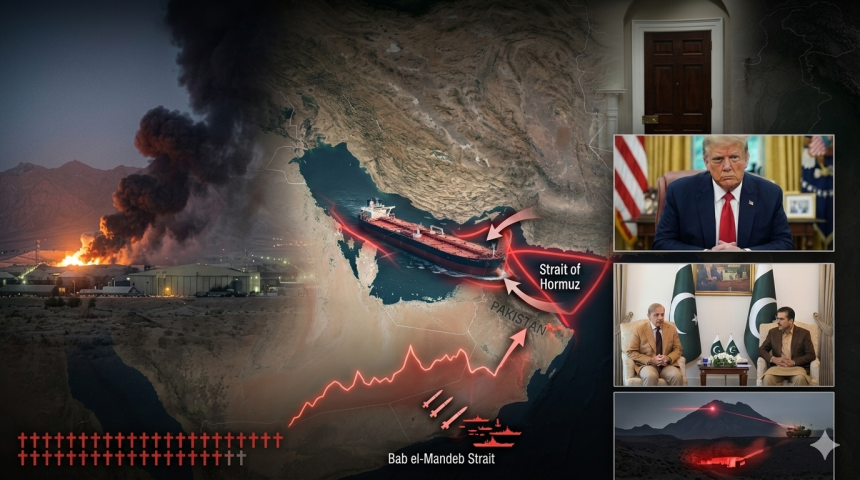
Strikes hit aircraft hangars and drone depots as diplomacy stalls in Islamabad — and a new front opens in the Red Sea
The bombs kept falling into Wednesday morning, marking the 11th consecutive night of American airstrikes on Iran, even as a fragile diplomatic track in Pakistan struggled to find any traction.
U.S. Central Command confirmed the latest wave of strikes targeted aircraft hangars and drone storage facilities — a signal that Washington is now going after Iran’s ability to sustain long-range strikes, not just its nuclear infrastructure. President Trump had already warned that the bombing campaign was about to intensify, and this round appears to be making good on that promise.
“No Interest in Meeting”
While missiles were falling on Iranian soil, Iran’s Interior Minister Eskandar Momeni was in Islamabad, meeting with Pakistan’s powerful army chief, Field Marshal Asim Munir, and later with Prime Minister Shehbaz Sharif. Pakistan brokered the interim ceasefire that briefly paused hostilities last month, and it’s clearly trying to resurrect that deal.
But from the Oval Office, Trump poured cold water on any breakthrough. He told reporters Iranian officials were desperate to talk — but that the U.S. wouldn’t engage until Tehran was ready to negotiate “in a meaningful way.” Then came the more ominous line: American forces would soon strike near Pickaxe Mountain, a heavily fortified underground site tied to one of Iran’s key uranium enrichment facilities.
Iran’s military didn’t take that quietly, warning through state media that any strike on nuclear or other “sensitive” sites would be treated as a major escalation — raising the stakes on an already combustible standoff.
A War Fought Over Oil Lanes
At the center of this conflict now sits the Strait of Hormuz — the narrow waterway that once carried roughly a fifth of the world’s oil and gas. Despite the relentless U.S. bombing campaign, Iran hasn’t loosened its grip on the strait. Tankers keep getting hit: a vessel came under attack off Oman early Tuesday, forcing its crew to abandon ship, and Iran’s Revolutionary Guard claimed responsibility for that attack plus two others earlier in the week.
The U.S. Navy has been quietly waging its own version of a blockade — redirecting eight commercial vessels and disabling one as of Tuesday, according to CENTCOM.
The ripple effects are already showing up at the pump. Crude oil pushed past $92 a barrel, and U.S. gasoline prices have climbed to around $4 a gallon — numbers that are landing squarely in the middle of a politically charged countdown to the U.S. midterm elections this fall, at a moment when polling shows Americans increasingly souring on the war.
A Second Front Opens in the Red Sea
As if one blocked shipping lane wasn’t enough, Iran-aligned Houthi rebels in Yemen have now declared a naval blockade of Saudi Arabia in the Red Sea — opening an entirely new pressure point on global oil trade. Saudi Arabia had been leaning on a pipeline to the Red Sea as a workaround while Hormuz remained effectively closed; now that route looks shakier too.
A Houthi-run news outlet claimed six ships had already been forced to reroute after warnings from the group, though the Associated Press has not been able to independently confirm the claim. Houthi officials said shipping companies were told this week to steer clear of the Bab el-Mandeb Strait entirely.
Meanwhile, air raid sirens have become a nightly ritual across the Gulf — sounding in Bahrain and Kuwait as projectiles streak toward U.S. allies in the region, while Iranian air defenses have been activating around Tehran itself.
The Human Toll Is Rising Quietly
Away from the headlines about oil prices and strait blockades, the human cost of the war is climbing faster than official channels are reporting it. A U.S. official told the Associated Press that the number of wounded American troops has now passed 500 — notably higher than the Pentagon’s official public tally of 482, which the official said suffers from reporting delays built into the system rather than any deliberate undercount.
What Comes Next
With Trump publicly ruling out talks and threatening to strike even closer to Iran’s nuclear program, and with Tehran signaling any such move would be treated as a serious escalation, the war shows no sign of cooling off. Pakistan’s diplomatic efforts remain the only visible off-ramp — but with both sides trading blows in the Gulf, the Red Sea, and now potentially near Iran’s most sensitive nuclear sites, that off-ramp looks harder to reach by the day.