


It started as a joke. A taunt from a judge. A tweet from a young man in Boston. A funny name for a fake political party.
And then — somewhere between the overnight trains, the cockroach masks, the exam paper leaks, and 22 million Instagram followers — it stopped being funny. It became something that makes governments nervous. Something that makes police officers watch their own daughters protest from a distance and quietly say: “There comes a time when one needs to get on the streets.”
India’s Gen Z just found its voice. And it sounds nothing like what came before.
The Insult That Lit the Match
Every revolution needs a spark. For India’s Cockroach Movement, that spark came from the most unlikely place — the bench of the country’s highest court.
The Indian chief justice’s comments last month equating the youth with cockroaches drew widespread ire.
In a country where judges are treated with near-divine reverence, this was not a throwaway remark — it was a declaration about how the establishment views an entire generation. Young. Scurrying. Insignificant. Pests.
India’s youth heard it. And instead of shrinking, they did something extraordinary. They embraced it.
Abhijeet Dipke, a recent graduate of Boston University, pondered on X at the time: “What if all cockroaches came together?”
Four words. Twenty-two million followers. One movement that just marched into the heart of New Delhi.
From Boston to Jantar Mantar — The Man Who Started It All
Dipke, 30, left for the US two years ago to pursue higher studies in public relations. He was supposed to be building a career abroad, networking at Boston dinner parties, carefully staying out of Indian politics.
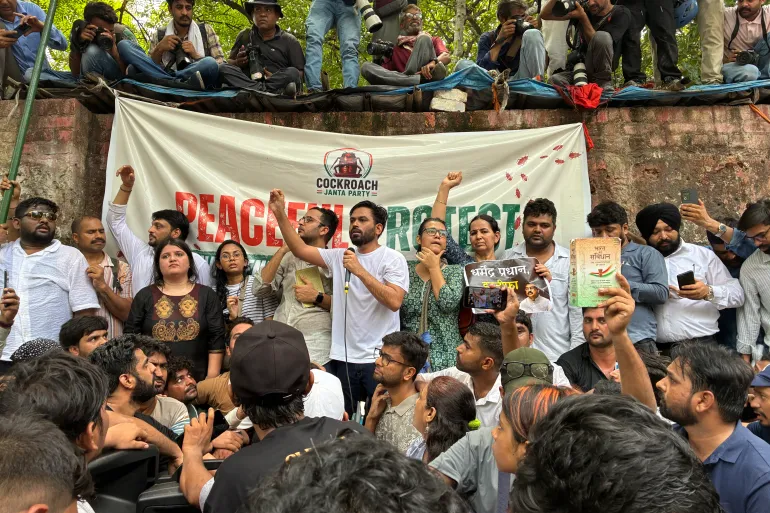
Instead, he flew back into the sweltering New Delhi heat — still dressed for the American chill in a black zip-up hoodie, with a cap pulled low over his face — and walked straight into a crowd of cameras, cockroach masks, roses, and young people who had travelled through the night just to see him.
In his opening words, Dipke recalled the anxious overnight flight, saying his family feared he would be arrested after landing in New Delhi.
Think about that. A 30-year-old man flying home to his own country — and his family is terrified he will be arrested at the airport. Not for carrying weapons. Not for committing a crime. For starting a satirical political party on Instagram.
“But this is not a fear only of my mother,” he told the crowd. “Every mother in this country fears that if one talks about politics, speaks against this government, they will be arrested.”
The crowd erupted. And in that moment — sweaty, defiant, drenched in New Delhi’s merciless June heat — the joke officially became a movement.
The Boy From Madhya Pradesh Who Slept on a Footpath
Every big political story has a human face. This one has many. But start with Saurav Kushwaha, 17 years old, from a village in Madhya Pradesh.
Kushwaha packed just a change of clothes and boarded an overnight train with his elder brother to reach New Delhi early on Saturday.
The brothers rested on a footpath, waiting for Dipke to arrive from the United States.
A 17-year-old boy. An overnight train. A footpath in Delhi. All to stand in a crowd and demand that a minister resign.
Kushwaha has just cleared the 12th school-leaving exams from India’s Central Board of Secondary Education — a process mired in controversy over several discrepancies, including digital marking on answer sheets. He is not sure if he can afford higher education, but he is angrier about a government “that has been indifferent to the people who voted them to power.”
He did not come to Delhi for a holiday. He came because his future was tampered with — and nobody in power has been held responsible.
The Scandal That Made a Generation Snap
The anger in Indian youth — where half of the country’s 1.4 billion population is under 25 — has been simmering for a while, exacerbated by paper leaks and discrepancies in the country’s largest school boards.
These are not small administrative glitches. These are catastrophic failures that affect millions of students who spend years — sometimes their entire childhoods — preparing for one exam that will determine the trajectory of their lives.
The school board’s fiasco came just a week after the top medical examination for graduates was cancelled after the paper was leaked. Such events, students say, are an annual affair, with no political accountability.
Annual. Affair. No. Accountability.
That combination — repeated failure, zero consequences, systematic indifference — is precisely what turns frustrated students into protesters. And protesters into movements.
The Cockroach Janata Party had called for “all cockroaches to assemble” at New Delhi’s Jantar Mantar to demand Education Minister Dharmendra Pradhan’s resignation.
“The warning to the Modi government is simple: get the education minister to resign,” Dipke told the swelling crowd. “Or we will not leave from here.”
The Gig Worker in a Cockroach Mask
The most powerful moment of the entire protest did not come from Dipke’s speech. It came from a man climbing a tree.
Mohammad Aftab, a 28-year-old gig worker from one of Delhi’s satellite townships, climbed a tree to catch a clearer view of Dipke. He said he could not complete high school due to economic struggles, and instead delivers groceries for a living, with no social security net.
“To leave a day’s work could mean no dinner,” said Aftab, wearing a cockroach mask. “But still, I wanted to come here.”
A man who skips a day’s pay — potentially skips a meal — to stand in solidarity with students he has never met, whose exams he never got to take, whose opportunities he never had.
“I could not go to school, but there are millions of students who did not sleep at night for their exams, to make a life for themselves,” he said. “It is our duty to stand up with them and demand that the criminal minister resign.”
When the gig economy worker and the engineering aspirant stand in the same crowd wearing the same cockroach mask — that is not a protest anymore. That is a coalition.
The Police Officer Watching Her Own Daughter Protest
And then there is the image that will stay with you longest.
Standing far from the crowd, Shivani, a police officer who requested to be identified by her first name only as she feared repercussions from the government, watched the demonstration. Her elder daughter is among the protesters — and she said she does not mind.
A government employee. In uniform. Watching her child demand that the government she serves be held accountable. Afraid to give her full name. But not afraid to say what she thinks.
“These children are worried for their future, and as a parent, I’m too,” she said. “There comes a time when one needs to get on streets, no?”
When the police officer agrees with the protesters — even quietly, even anonymously — the government should pay attention.
22 Million Followers. Zero Response From Delhi.
Dipke’s casual joke attracted more than 22 million followers on Instagram — double that of Modi’s party, which has been in power since 2014.
Let that number sink in. A satirical party born from a courtroom insult has twice the Instagram following of the ruling party of the world’s most populous democracy.
The government has not yet commented on the protests.
Silence. From the most powerful government in South Asia. Faced with a movement led by a man in a hoodie, backed by a 17-year-old on a footpath and a gig worker in a cockroach mask.
That silence says more than any press conference could.
India’s Gen Z Has Only Known One Government. Now It Is Angry.
India’s Gen Z population — the largest such cohort in the world — has only seen the rule of Modi’s Hindu nationalist BJP.
This is the generation that was promised a Digital India, a New India, a Viksit Bharat. Instead, they got leaked exam papers, cancelled medical tests, and a chief justice who compared them to cockroaches.
They did not choose that name in defeat. They chose it in defiance.
“To everyone who believes that Indian youth only post on social media, come down here and see this,” Dipke told the crowd — now donning the Indian cricket team’s blue jersey, drenched in sweat, still standing. “And to those who think we will go away after shouting — we are cockroaches and we will stay until the minister resigns.”
Cockroaches, as anyone who has ever tried to get rid of them knows, are extraordinarily difficult to exterminate.
India’s government may be about to find out exactly how true that is.