

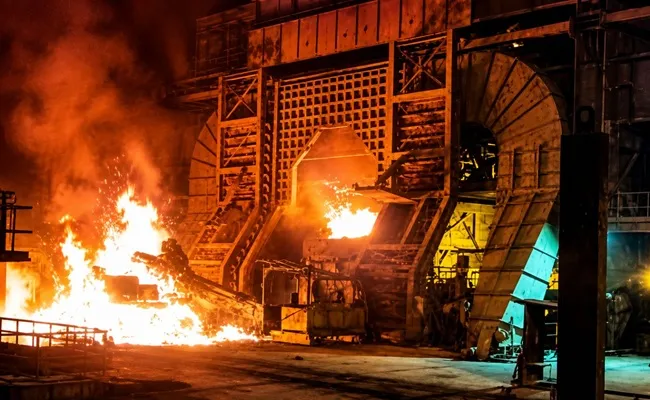
The ladle was carrying steel at 1,500°C. One mechanical failure. Explosive fire. Nine workers trapped in the blaze.
By the time emergency teams arrived, the molten metal had already done its deadly work.
This isn’t just another industrial accident. It’s a careless safety failure that could have been prevented—and it’s happening right now at India’s biggest steel plants.
The Nightmare That unfolded at 4:30 PM
The accident struck around 4:30 PM Monday at the Steel Melt Shop (SMS-1) section of Rashtriya Ispat Nigam Limited (RINL)—the official name for Visakhapatnam Steel Plant.
A ladle carrying molten steel suddenly malfunctioned, spilling massive quantities of liquid metal. The intense heat and resulting fire trapped workers in the vicinity, leading to multiple casualties.
Circle Inspector Kesav Rao confirmed: eight workers lost their lives and several others sustained injuries after the molten steel leak caused by the explosion.
But trade union leaders claim nine bodies have been recovered, while RINL management hasn yet issued an official statement confirming the death toll.
What This Means for YOU: Every Steel Worker in India
BEFORE: Steel plants operated with minimal safety oversight
NOW: Nine deaths force nationwide safety review
| Safety Standard | India’s Reality | Global Benchmark |
|---|---|---|
| ISO 45001 | Not mandatory | Required in Japan, Germany |
| OHSAS 18001 | Voluntary | Mandatory in South Korea |
| Real-time monitoring | Rare | AI-driven (POSCO Korea) |
| Predictive maintenance | Manual | Automated systems |
| Fatality rate | 10x higher | Near-zero in developed nations |
India must adopt international safety benchmarks like ISO 45001 and OHSAS 18001. Mandatory compliance across all steel plants can bridge the gap between India and global leaders.
The Science Behind the Horror
Molten steel at 1,500°C doesn’t just burn—it melts. Workers caught in the spill had seconds to escape.
The ladle hooks carrying hot liquid steel came off, spilling the steel in a previous 2020 accident at the same plant.
Key hazards in steel plants include: traffic conditions, manual handling issues, working at heights, confined spaces, and electrical risks.
“This Shouldn’t Have Happened”
A local trade union leader, requesting anonymity, said: “The ladle carrying molten steel suddenly malfunctioned, causing a large quantity of liquid metal to spill. The intense heat and resulting fire trapped workers in the vicinity.”
Another union leader added: “A substantial volume of molten steel leaked while being lifted, triggering a massive blaze.”
Technological advancements such as real-time monitoring systems for gas leaks, automated slag handling, and predictive maintenance tools can prevent accidents. For instance, POSCO in South Korea uses AI-driven systems to monitor furnace conditions, achieving near-zero fatalities.
The Global Context: India’s Safety Gap
Globally, steel producers prioritize safety through stringent standards and technological innovations. Countries like Japan, Germany, and South Korea have achieved exemplary workplace safety records, with accident rates substantially lower than India’s.
2012 Horror: 16 workers burned alive in oxygen plant explosion at same facility.
2025 Near-Miss: 300 tonnes of molten steel spilled, but no casualties reported.\
2026 Deaths: 9 workers killed in SMS-1 facility.
Authorities are expected to conduct a detailed inquiry to ascertain the exact cause and determine whether any safety lapses contributed to the tragedy.