


Forget killing time at the departure gate with overpriced coffee and duty-free perfume. Some of the world’s greatest airports will hand you a free city tour — no strings attached. All you need is a long enough connection and the nerve to walk out those doors.
Picture this. You have an eight-hour layover. Your next gate does not open for hours. The airport food court is doing its best, but its best is a soggy sandwich and a bottle of water that costs more than your cab ride to the airport. You stare at the departures board. You scroll your phone. You consider, briefly, whether you have enough time to nap on those chairs that seem specifically designed to prevent sleeping.
Now picture this instead: you are standing at the foot of a 600-year-old Korean temple, watching the morning light fall across ancient stone while a guide explains the dynasty that built it. Or you are riding a bus through Singapore’s glittering skyline as the Gardens by the Bay unfold outside your window, all of it completely free, before you board your connecting flight.
This is not a fantasy. This is a travel secret that millions of frequent flyers already know — and one that far too many people miss simply because nobody told them it existed.
Several of the world’s busiest airports offer free transit tours — fully guided, professionally organised city experiences for passengers on long layovers. No extra hotel booking. No visa panic. No additional cost. Just your boarding pass, your passport, and a willingness to step outside the terminal.
Here is your guide to the best of them.
SINGAPORE: WHERE THE LAYOVER BECOMES THE DESTINATION
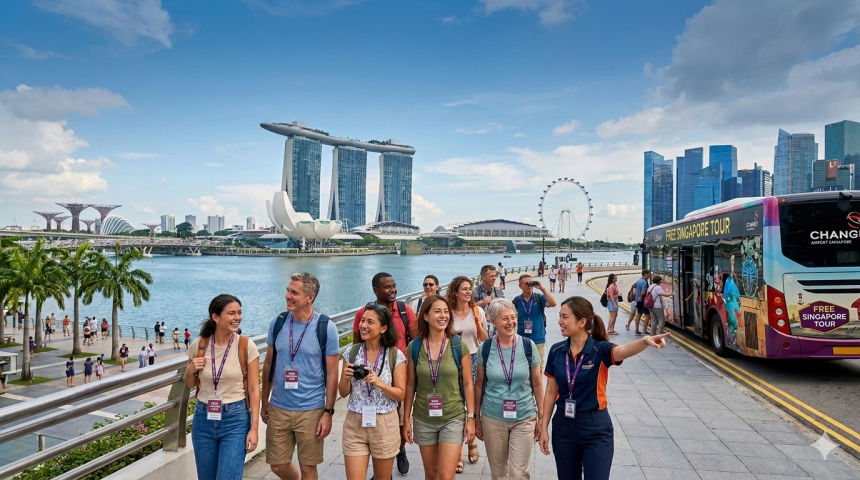
Singapore’s Changi Airport — consistently ranked the world’s best — runs a free city tour programme for transit passengers with layovers between 5.5 and 24 hours, jointly subsidised by Changi Airport Group, Singapore Airlines, and the Singapore Tourism Board.
If you have a 5.5-hour layover or longer at Changi, you have a choice of three city bus tours, each lasting 2.5 hours. Routes take in Singapore’s most iconic landmarks — Gardens by the Bay, Marina Bay Sands, the gleaming towers of the financial district — and cultural heritage neighbourhoods that most tourists on dedicated holidays barely find time to explore.
The service relaunched in April 2023 after COVID-19 suspension, expanding from five to nine daily departures to accommodate growing demand. Pre-pandemic, the programme served 80,000 passengers annually, with one-third originating from India, Australia, and Indonesia.
The logistics are simpler than you might expect. Upon arrival, stay in the transit area, do not go through Arrival immigration, and stop by one of the Free Singapore Tour booths in Terminal 2 or Terminal 3. You can also book up to 50 days in advance online — sensible if you are a planner — or simply walk up and register on the day.
One important detail: Singapore enforces a zero-tolerance ban on e-cigarettes and vaporisers, and it applies even if you are just transiting. Possession is a criminal offence carrying fines up to SGD 2,000. Leave the vape in your checked luggage — or better yet, leave it at home.
Singapore is one of the most expensive cities in Asia. The fact that you can see it properly, guided, without spending a cent on transport or entry, is a travel deal that borders on absurd generosity.
SEOUL: THIRTEEN TOURS, ZERO COST, ONE UNFORGETTABLE LAYOVER
If Singapore is the polished gem of the free transit tour world, Seoul is the one that leaves you genuinely speechless.
During a layover at Incheon International Airport, you can plan a free visit to Hongdae Street, stop into the futuristic INSPIRE Entertainment Resort — which has a casino, mall, and immersive media art exhibition — take a ferry ride from Gu-eup Ferry Terminal to Wolmi Park in the heart of Incheon’s old town, or sample street food at Sinpo International Market, especially known for its crispy fried chicken in spicy sauce. History buffs can instead opt to visit Cheong Wa Dae, which served as the presidential presidential residence from 1948 to 2022, or Jeondeungsa Temple.
The Transit Tour is open to passengers with layovers of 24 hours or less, with options ranging from about one hour to five hours. Tours cover popular sights like Gyeongbokgung Palace, traditional Korean villages, temples, and duty-free shopping districts, run by guides licensed by the Korean tourism authorities.
Eligibility covers passengers from visa-free countries, passengers holding a valid visa or permanent residency for the US, Canada, Australia, New Zealand, or 32 listed European countries, and general foreign transit passengers who meet the programme’s conditions.
One traveller who took the five-hour Tradition tour described arriving at Gyeongbokgung Palace — the largest of Seoul’s five royal palaces, built in 1395 when the Korean capital shifted from Kaesong — and feeling entirely overwhelmed that this was happening during what was technically a connecting flight. The tour bus had free onboard WiFi, and the hour spent exploring Hongdae’s crowded shopping streets and eating fishcake and tteokbokki from street food stalls felt like a proper afternoon in the city.
Seoul has quietly become one of Asia’s most important transit hubs, emerging as a major alternative following Gulf airspace disruptions that forced airlines to redraw long-haul routes. If your flight path takes you through Incheon, the layover tour is not just a nice bonus. It is a genuine reason to choose this route over another.
ISTANBUL: SEVEN TOURS AND A BOSPHORUS CRUISE
If there is one city that seems tailor-made for a dramatic layover experience, it is Istanbul — a place where two continents meet, where 3,000 years of history sit shoulder to shoulder with contemporary art galleries and rooftop bars.
Turkish Airlines passengers with international transfer flights and at least six hours to spare have access to a series of seven different complimentary Touristanbul tours. The shortest lasts 3.5 hours and includes Taksim Square and the Aqueduct of Valens, with a stop for photos on the Galata Bridge. The 9.5-hour full-day tour includes breakfast and lunch and visits to the Ottoman-era Blue Mosque, the Grand Bazaar, and Topkapı Palace.
Among the free itineraries is a seasonal Bosphorus cruise — a boat journey along the strait that separates Europe from Asia, with minarets and Ottoman palaces drifting past on either shore. It is the kind of thing that appears on travel bucket lists and costs serious money for dedicated tourists. For Turkish Airlines transit passengers, it is simply Tuesday.
You do not need to book in advance. Just show up at the Touristanbul Desk in the Transfer area of Istanbul Airport and join the next available tour. The spontaneity is half the appeal.
TOKYO: THREE HOURS OF ANCIENT JAPAN
Narita International Airport in Tokyo offers a free city tour through the Narita Airport Transit and Stay Programme, led by English-speaking volunteer guides. The three-hour tours cover cultural sites like Naritasan Shinshoji Temple, Omotesando Street, and traditional experiences. While the guided tour itself is free, participants must cover personal expenses including transportation, starting at 500 yen.
Five hundred yen. That is roughly three US dollars to stand inside a temple complex that has been drawing pilgrims for over a thousand years. Even by the most generous accounting, this is an extraordinary use of a layover afternoon.
Booking is available online or in person at the tour desk, which opens from 9am to noon. Worth noting: if your Tokyo connection is through Haneda rather than Narita, the transit tour programme does not apply — Haneda is closer to the city and accessible by metro, but does not run a dedicated guided programme.
TAIPEI: FOUR TOURS, FOUR PERSONALITIES
Passengers connecting through Taipei with layovers between seven and 24 hours can take advantage of a free half-day city tour. Offered by Taoyuan International Airport, each of the four guided tours focuses on either history, traditional arts, nature, or a night market experience and lasts around three to four hours. Limited to 18 participants, seats can be reserved online five to 90 days before arrival, although same-day bookings may be available at the Tourist Service Centres in the arrival lobbies of Terminal 1 and Terminal 2.
The night market tour is the one that draws the longest waiting list — and for good reason. Taiwan’s night markets are not a tourist attraction bolted onto the city. They are the city, in its most vivid, fragrant, loud, and delicious form. Bubble tea, scallion pancakes, stinky tofu that smells alarming and tastes revelatory — all of it under neon lights, all of it within reach of your departure gate.
DOHA: DESERT LUXURY ON A LAYOVER
Hamad International Airport in Doha offers passengers with layovers between four and eight hours the opportunity to explore Qatar with the Discover Qatar Tour.
Doha has invested extraordinary sums in transforming itself into a cultural destination — the Museum of Islamic Art, the Katara Cultural Village, the Souq Waqif with its labyrinthine alleyways — and the transit tour programme is its way of showing off that investment to the millions of passengers who pass through Hamad’s gleaming terminals every year.
For travellers connecting between Europe and Asia, the Middle East, or Australia, a Doha transit is already common. The tour makes it something worth specifically planning for.
THE RULES OF THE FREE LAYOVER TOUR
Before you start rerouting your next international itinerary through Seoul and Singapore, a few practical realities worth knowing.
Most programmes operate on a first-come, first-served basis. Book online in advance whenever the option exists — particularly for Singapore and Taipei, where demand consistently outstrips availability. Arrive at the registration desk early. Bring both your passport and your onward boarding pass, as both are required for verification.
Visa requirements vary. Citizens of 67 countries and territories — including the United States, the UK, Canada, Australia, Singapore, Japan, and most EU states — are currently exempt from the K-ETA requirement for South Korea transit tours. Check the specific requirements for your nationality before banking on participation.
Budget for the fact that leaving the airport costs nothing on the tour itself — but lunch, souvenirs, street food, and the occasional irresistible temple entrance fee are yours to cover.
And perhaps the most important rule of all: do not cut it too fine. Leave enough buffer between your tour return time and your departure gate. History has a habit of making you lose track of time — and no ancient palace is worth missing your flight over.
WHY THIS CHANGES HOW YOU SHOULD BOOK FLIGHTS
Here is the lifestyle shift that frequent travellers have already made: they no longer choose connecting flights purely on price and duration. They choose them on opportunity.
A six-hour layover in Seoul is not six hours of airport purgatory. It is a morning at Gyeongbokgung Palace. A seven-hour connection in Istanbul is not dead time. It is a Bosphorus cruise and lunch at the Grand Bazaar. Singapore does not have to be a destination on its own itinerary — it can be a bonus afternoon, gift-wrapped into a flight you were already taking.
The world’s best airports figured out something that most travellers have not yet caught up with: the journey itself can be as rich as the destination. You just have to know where to show up — and have the courage to walk out of the terminal.
Your next layover is not an inconvenience. It is an invitation.