


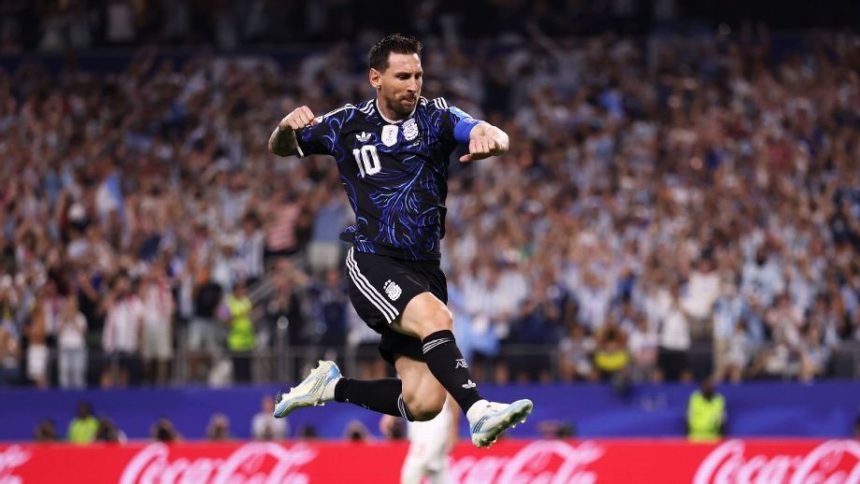
There are football records, and then there are Lionel Messi records. The kind that make you stop mid-sentence, stare at the number, and quietly accept that you are watching something that will never happen again.
June 27, 2026, delivered another chapter in that story — and it was not alone. From Argentina’s commanding win over Jordan to Harry Kane finally stepping out of Gary Lineker’s shadow, and a 40-year-old Luka Modric rewriting the history books in Croatia’s colours, the final day of the FIFA World Cup 2026 group stage produced a stat sheet that reads less like a football report and more like a hall of fame induction ceremony.
Let us walk through every jaw-dropping number — because there were many.
MESSI: THE RECORD THAT STANDS ALONE
Seven. That is the number that defines this World Cup so far for Lionel Messi.
The Argentina captain scored against Jordan in a 3-1 victory to become the first player in FIFA World Cup history to score in seven consecutive appearances at the tournament. Not in seventy years of modern football. Not in six World Cup cycles since 1966. Never. No one had done it before him — and given the trajectory of the sport, it is difficult to imagine anyone matching it anytime soon.
But Messi did not stop there. The goal was also his 19th in World Cup history — extending his own all-time record as the tournament’s greatest scorer. He is now six clear of Cristiano Ronaldo, who sits second on the all-time list.
The detail behind the goals matters too. Messi scored twice from direct free kicks against Jordan, becoming only the sixth player in the last 60 years to score two direct free-kick goals at a World Cup. He now has six World Cup goals from outside the penalty area — more than any other player in tournament history in the last six decades, surpassing Brazilian legend Rivellino.
Perhaps the most extraordinary number of the night: Messi became the fifth player ever — and the first since Russia’s Oleg Salenko in 1994 — to score six goals in a single World Cup group stage. That places him in company so rarefied it barely has a name.
Argentina, for their part, won all three group games for the fifth time in their history. They are on a nine-game unbeaten run at the World Cup stretching back to Qatar 2022. The machine is running. Messi is its engine.
HARRY KANE BURIES A GHOST NAMED LINEKER
For years, the question haunted Harry Kane every time England played at a World Cup: when would he pass Gary Lineker?
On Friday night in a 2-0 win over Panama, the answer finally arrived.
Kane scored his 11th FIFA World Cup goal — one more than Lineker’s long-standing England record of 10 — to become his country’s all-time leading scorer at the tournament. It was a moment that had been building across three World Cups, and when it came, it felt entirely inevitable for a striker of Kane’s cold, relentless efficiency.
There were other records too. England finished first in their group in consecutive World Cups for the very first time in the nation’s history — a quiet but significant milestone for a team that has spent decades being the tournament’s great underperformers.
Jude Bellingham added a goal and an assist, becoming the youngest Englishman to score and assist in a World Cup match. He is 22. He is just getting started.
Panama, meanwhile, ended their World Cup campaign without scoring a single goal across six matches — the first team since Honduras and Algeria in 2010 to finish a group stage scoreless. A sobering ending to a tournament they will want to forget quickly.
LUKA MODRIC AT 40: DEFYING EVERYTHING
Age is supposed to slow footballers down. Someone forgot to tell Luka Modric.
The Croatia captain, aged 40 years and 291 days, became the oldest player to provide an assist at a FIFA World Cup since 1966 — setting up a goal in Croatia’s 2-1 win over Ghana that sealed both teams’ qualification for the knockout stage.
He and Ivan Perisic became the first Croatians ever to start 20 FIFA World Cup matches. Croatia themselves are only the fourth nation in history to have multiple players reach that landmark.
At 40, playing in his fifth World Cup, Modric is producing moments that players half his age can only dream about. That assist did not just book Croatia’s place in the last 32. It rewrote the record books for an entire generation of players.
RONALDO CHASES HISTORY OF HIS OWN
While Messi was breaking records in one corner of the World Cup, Cristiano Ronaldo was quietly hitting a milestone of his own in Colombia’s goalless draw against Portugal.
Ronaldo made his 25th appearance for Portugal at a FIFA World Cup — drawing level with Germany’s Lothar Matthäus for the second-most World Cup appearances in tournament history. Only Messi, with 29, has played more matches.
The draw itself meant Portugal finished second in their group, a result that has fuelled widespread debate about whether the two greatest players of their generation will now miss each other in the knockout rounds — robbing the world of one final Messi versus Ronaldo World Cup showdown. Portugal’s route through the bracket makes a potential meeting with Argentina possible, but the draw has made it harder. For fans who have spent two decades watching this rivalry define football, that possibility feels both precious and precarious.
CONGO DR: THE COMEBACK STORY OF THE TOURNAMENT
If Messi’s records dominated the headlines, the story that captured hearts on June 27 belonged to Congo DR.
In a 3-1 win over Uzbekistan, Congo DR qualified for the FIFA World Cup knockout stage for the very first time in their history. For a football nation that has existed on the margins of the global game for decades, this is not just a result — it is a transformation.
Yoane Wissa was the architect, scoring three goals in the tournament — the same number he managed for Newcastle United across 28 appearances last season. He became only the fourth African player to score three goals in a World Cup group stage. Congo DR also pulled off the night’s most dramatic second-half performance, scoring three goals after the interval after managing just one across their first five and a half matches combined.
ALGERIA VS AUSTRIA: THE MATCH THAT DEFIED HISTORY
The final game of the evening produced the most dramatic moments of the night — and some of the most extraordinary statistics ever recorded in a World Cup fixture.
Algeria and Austria drew 3-3 in a match that became the first in World Cup history to feature a go-ahead goal and a game-tying goal scored in stoppage time by both teams. Read that again. Both teams scored in stoppage time to either take the lead or draw level. It had never happened before in over 70 years of the competition.
Riyad Mahrez, at 35 years and 126 days, became Algeria’s oldest ever goalscorer at a World Cup. Sasa Kalajdzic scored a 96th-minute equaliser for Austria — his first World Cup goal and his first international goal in five years. Marko Arnautovic became only the fourth player aged 37 or older to score multiple goals in a single World Cup, joining Messi, Roger Milla, and Ronaldo in that company.
Both teams qualified for the knockout rounds. Both teams were almost disqualified from history in the same breath. Football, as always, refused to make it simple.
THE BIGGER PICTURE
Stand back from the individual numbers and what emerges is a portrait of a World Cup that is already producing history at a pace that tournaments twice its size rarely manage.
Messi’s seven consecutive scoring appearances. Kane’s record-breaking 11th goal. Modric defying time at 40. Congo DR reaching a knockout stage for the first time. A 3-3 draw that invented a category of drama the tournament had never seen before.
The group stage is over. The records are set. Now the real tournament begins.
And somewhere in this World Cup bracket, Lionel Messi is still playing — still scoring, still breaking things that were never meant to be broken — with the look of a man who is not remotely finished yet.