



Every altitude above Earth already belongs to someone — planes below, satellites far above. Dr. C. V. S. Kiran spent his career on learning what machines are made of before deciding to build one for the only layer of sky nobody had claimed.
There is a strip of atmosphere roughly twenty to twenty-five kilometres up that has never really had an owner. Commercial jets cannot climb into it; the air is too thin for their wings. Satellites sail past it on their way somewhere else; orbit begins hundreds of kilometres higher. For most of the history of flight, this stratum has functioned as a kind of no-man’s-land — a place engineers flew through, briefly, on the way to somewhere that mattered more. Dr. Chakravadhaanula Venkata Sai Kiran built a company on the premise that this was a mistake.
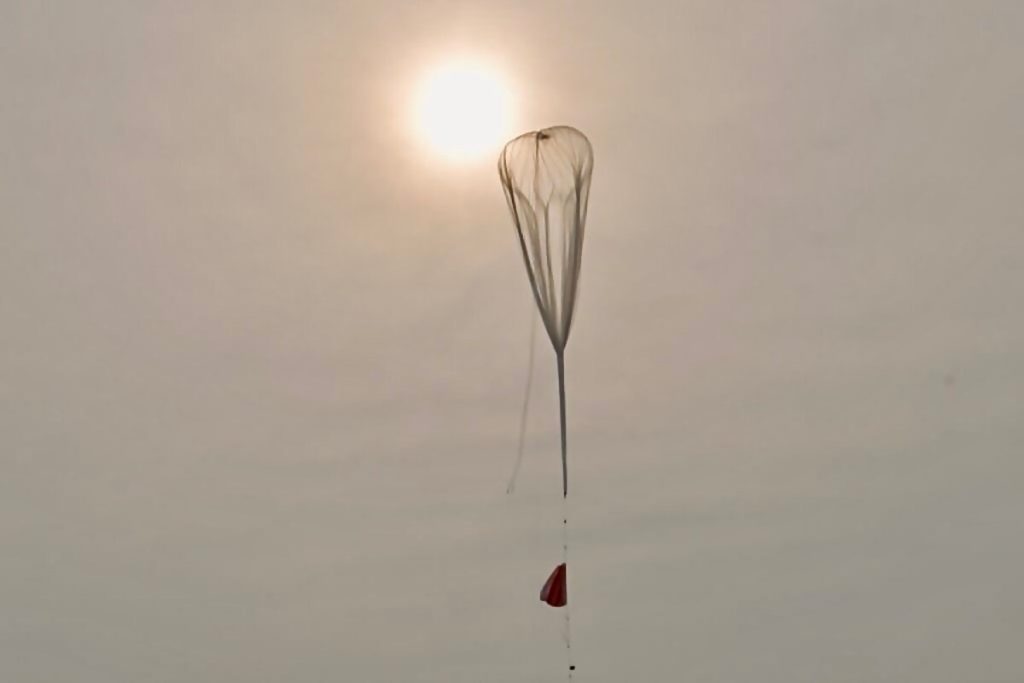
The proof arrived on 27 May 2026, and it arrived somewhere unexpected. Rather than a fenced-off launch range, the venue was the Indira Gandhi Municipal Stadium in Vijayawada — a cricket ground, packed that morning with people who had shown up for an entirely different kind of spectacle. Instead, they watched a balloon: a vast envelope of engineered film, filled with hydrogen, lifting off the pitch in near silence. It kept rising long after ordinary aircraft would have levelled off, past the altitude where jet engines lose their grip on the air, until it settled onto an invisible shelf nearly 25 kilometres above the ground. Riding inside it were seven experimental payloads contributed by Indian and international partners — biology, propulsion, earth observation, navigation. The balloon then did the hard part: it held that altitude through an entire cycle of stratospheric day and night, a thermal swing brutal enough to rupture most conventional balloons within hours. By surviving it, India became the fifth country on the planet — after the United States, France, Japan and China — to demonstrate home-grown super-pressure stratospheric flight.
The flight was named Mission SANA. The company that built it, Red Balloon Aerospace, had existed for barely eight months — a timeline that puts it among the fastest concept-to-flight programmes anywhere in the global near-space industry. Kiran, its co-founder and chief executive, watched the balloon disappear into the haze knowing it carried rather more than seven experiments. It carried the argument he had been building toward for the better part of two decades.
A Gap Masquerading as an Obstacle
Kiran’s pitch to early believers was never framed as ambition for its own sake. It was framed as an accounting error the aerospace industry had never corrected. Aircraft own everything below roughly ten kilometres. Satellites own everything above a few hundred. In between sits a corridor wide enough to be useful and, until recently, difficult enough that almost nobody had bothered to hold it. His insight was that difficulty is exactly what made it valuable: a platform that can sit in that corridor for weeks at a time can watch one location continuously, at a fraction of what a satellite launch would cost — trading altitude for endurance.
The fleet Red Balloon has built around that insight functions less like a product line and more like a layered piece of infrastructure. VISTA — the super-pressure balloon that flew Mission SANA — is built for long-duration observation and payload testing. ALTIS, a family of tethered aerostats designed for long endurance, holds position closer to the ground for surveillance and communications work. HELIX, a hydrogen-lift cargo airship still in accelerated development, is aimed at moving freight into places with no roads and no runways. Threading through all three is DIVE, an AI intelligence layer whose job is to turn hours of altitude into something closer to understanding. Laid end to end, the fleet’s intended uses map almost exactly onto India’s list of unmet strategic priorities: reconnaissance, 6G non-terrestrial network backhaul, connectivity when disaster wipes out ground infrastructure, and a foothold in a layer of sky no international treaty has yet carved up.

Kiran’s own description of the moment, after the balloon reached altitude, was almost anticlimactic: “VISTA validates our core near-space platform technology, and this is only the beginning.” It is a modest sentence for a team that had just folded a national first into two hundred and forty days of work.
“One Earth, One Space — wherever we cross the Kármán line, we are from Earth.”
A DECADE OF LEARNING WHAT THINGS ARE MADE OF
None of this happened quickly, whatever the headlines from May suggested. Kiran trained as a materials scientist, a field less concerned with what a machine does than with what it can survive — the alloys, coatings and composites that decide whether hardware fails quietly in a lab or catastrophically in the field. His formal education began with a B.Tech in metallurgy and materials technology at MGIT–JNTU Hyderabad, including an undergraduate thesis completed at the Bhabha Atomic Research Centre. From there he moved to Germany for what became more than a decade of research work: a doctorate at Christian Albrechts University in Kiel focused on nanocomposite thin films and ion-beam modification, followed by scientific appointments at the Karlsruhe Institute of Technology and the Helmholtz Institute Ulm. The tally from those years reads like the résumé of a career academic rather than a future rocket-and-balloon entrepreneur: more than a hundred peer-reviewed papers, an h-index of 41, a DAAD Award, and fellowships from both the Andhra Pradesh and Telangana academies of science.
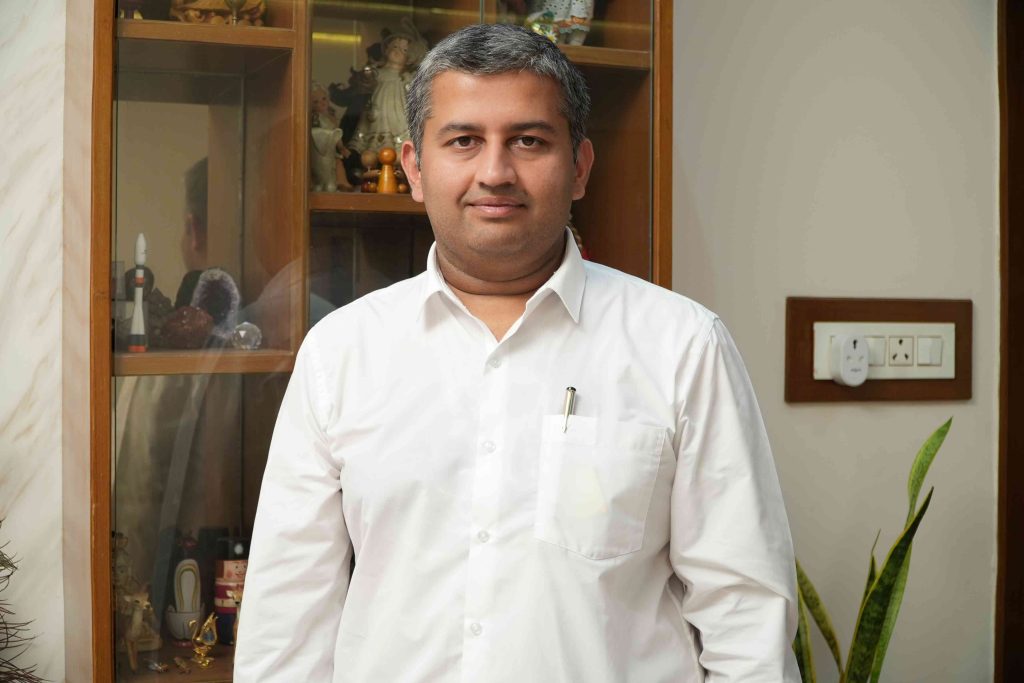
The return to India redirected all of it toward hardware that actually flies. At ISRO’s Vikram Sarabhai Space Centre, Kiran worked on the materials used in launch vehicles — unglamorous, exacting work in characterisation and reliability that every mission depends on without ever crediting by name — and earned the Excellence in Microscopy Award in 2020 for it. When India opened its launch industry to private companies, he moved to Hyderabad’s Skyroot Aerospace as Vice President for materials and strategic initiatives, and was part of the team behind Mission Prarambh — the 18 November 2022 flight of Vikram-S, the first rocket built by a private Indian company ever to leave Indian soil. He has described those years less as a job than as an atmosphere: long nights of testing, and a shared conviction among the team that carried them through each milestone. The principle he says he took from it is the one now steering Red Balloon — that real innovation only shows up where courage and collaboration intersect, not where either exists alone.
TRADING SPEED FOR STAYING POWER
Some outside observers found the shift from rockets to balloons an odd career turn. It is less odd than it looks. A rocket’s achievement is measured in minutes; once the payload separates, everything that follows belongs to orbital mechanics, not to the people who built the vehicle. Kiran’s newer machines were designed to do the opposite — to remain aloft, working, for as long as the mission requires. He describes the move not as leaving rockets behind but as extending the same engineering philosophy to a different problem: vehicles at Skyroot that were built to reach; infrastructure at Red Balloon that is built to stay. In 2025 he was named a Karman Fellow, joining an international group of space-industry leaders, and that same year co-founded Red Balloon Aerospace in Vijayawada alongside Sireesh Pallikonda, an aerospace veteran with a background spanning HAL and SES. The company’s advisers include figures connected to the TIFR Balloon Facility in Hyderabad, an institution that has quietly sent scientific payloads into the stratosphere for decades, long before near-space became a category anyone invested in.
The business model mirrors the engineering in how deliberately it is built. A single VISTA flight is designed to carry several customers’ payloads at once, splitting the cost of a stratospheric mission across multiple industries rather than asking any one customer to fund a flight alone. The model’s reach extended beyond India within three weeks of Mission SANA’s success, when Red Balloon signed a memorandum of understanding on 17 June 2026 with Armenia’s Bazoomq Space Research Laboratory to run joint stratospheric flight campaigns and test payloads together — an early sign that what India built for itself, it can also sell abroad.
WHY IT MATTERS NOW
Analysts put the value of the global near-space market above a hundred billion dollars, and the countries positioning themselves for a share of it are not pausing to let anyone catch up. High-altitude platforms already appear in serious 6G infrastructure planning worldwide; persistent stratospheric surveillance is starting to change how nations monitor their own borders and coastlines. For India, the underlying question was familiar long before Kiran answered it — whether to import this kind of capability or build it domestically. His answer flew over a cricket stadium in May, in front of an audience that had not come looking for it.
What separates Kiran from many of his peers in India’s expanding private-space sector is less any single achievement than the completeness of the path that led to it: fundamental materials research inside some of Germany’s most demanding institutions, mission-critical engineering inside ISRO, the high-pressure realities of a private rocket startup at Skyroot, and now a growing role shaping policy — engaging with IN-SPACe, ISPA and industry groups on how India ought to regulate the very domain his company is opening up. He sums up his own view of the work in a single line: one Earth, one space; wherever we cross the Kármán line, we are from Earth.
The Kármán line, the internationally recognised boundary of space, sits at 100 kilometres. Kiran’s argument is that the more valuable ground of the next decade lies well beneath that line — in the calm, cold, sunlit layer where his balloons now operate, and where India has, for the first time, planted a flag of its own making.
— Rashmi Kumari