


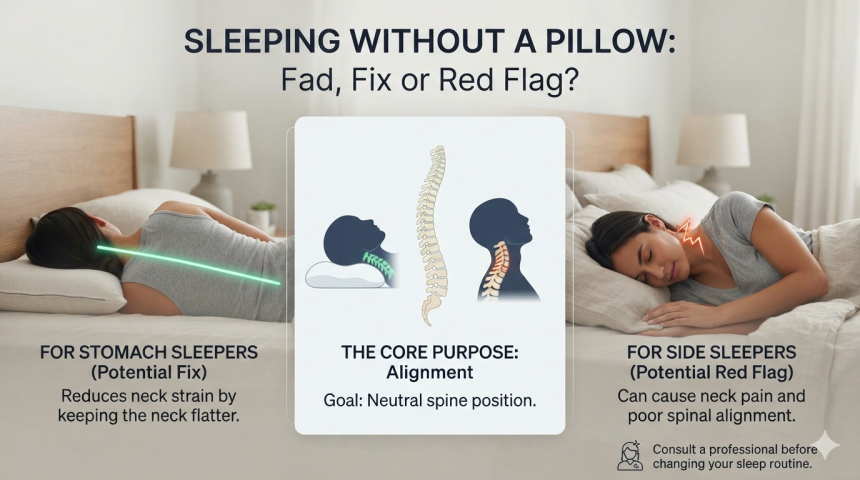
From “flat sleeping” trends on social media to minimalist wellness hacks, more people are asking a simple question: is sleeping without a pillow actually better for you? The answer, like most things in health, depends heavily on your body, your usual sleep position and any existing neck or back issues.
Here’s a clear look at what science and sleep experts say about ditching your pillow – and when it might help or hurt.
What pillows actually do
A good pillow isn’t just fluff; it’s a support tool. Its main job is to keep your head, neck and spine aligned in a neutral position while you sleep. When that alignment is off, muscles have to work harder, and joints are strained, which is why you often wake up with stiffness or a dull ache after a bad night’s sleep.
So the question isn’t “pillow or no pillow?” in isolation – it’s “what keeps your spine neutral in your preferred sleeping position?”
When sleeping without a pillow may help
Sleeping without a pillow can reduce strain in some very specific situations:
- Stomach sleepers
If you sleep on your stomach, a thick pillow can force your neck into an awkward backward bend and twist, increasing pressure on your spine. For such sleepers, a very thin pillow or no pillow at all can sometimes feel better because it keeps the head closer to the mattress and reduces extreme neck extension. - Certain lower-back issues
Some people with mild lower-back discomfort feel better when their entire body is more level, especially if they combine no head pillow with a small pillow under the pelvis. That can reduce the excessive inward curve of the lower back when sleeping on the stomach.
Even in these cases, the goal is still alignment – you’re simply using less height under your head so the spine stays straighter.
When no pillow can make things worse
For many people, especially back and side sleepers, sleeping without a pillow can actually create or worsen problems:
- Side sleepers
Without a pillow, your head drops sideways toward the mattress, pulling your neck sharply down and bending the spine. Over time, this can cause neck pain, shoulder tension and even headaches. - Back sleepers
On your back, no pillow often lets the head fall slightly backward, increasing the arch in your neck. That can tighten neck muscles and may aggravate issues like cervical spondylosis or chronic stiffness. - Existing neck or shoulder pain
If you already have neck pain, frozen shoulder, or upper-back issues, suddenly ditching your pillow can overload structures that are already struggling. - Sleep apnea and snoring
For some people, particularly back sleepers, a small amount of elevation can help keep airways more open. Going totally flat may worsen snoring or mild obstructive sleep apnea, though this varies from person to person.
What about posture and “natural” sleeping?
A common argument is that “humans didn’t always use pillows” so we shouldn’t need them now. But our current lives are very different: many of us spend the day hunched over screens, with forward-head posture and rounded shoulders. That already puts strain on the neck and upper back.
At night, the body needs support to undo some of that stress. A well-chosen pillow can actually help neutralise daytime strain instead of adding to it.
How to experiment safely
If you’re curious about sleeping without a pillow, treat it like a test, not a permanent decision on day one.
- Step down gradually
Move from a thick pillow to a medium one, then to a thin or low-loft pillow. Jumping straight to no pillow can shock your neck and cause stiffness. - Match it to your position
- Stomach sleeper: try no pillow under the head, but consider a thin pillow under your pelvis to reduce lower-back strain.
- Side sleeper: instead of going pillow-free, aim for a firm pillow that fills the space between your shoulder and neck.
- Back sleeper: a low, supportive pillow that keeps your head in line with your chest is usually safer than none.
- Watch your body’s response
If you wake up with new or worse pain, headaches, tingling in arms or shoulders, or more fatigue, that’s a signal your current setup isn’t working.
Signs your current pillow is the real problem
Sometimes people think “no pillow” is the answer when the real issue is a bad pillow. Consider replacing your pillow if:
- It’s flat, lumpy, or more than 2–3 years old.
- You have to fold it or stack multiple pillows to feel supported.
- You wake with consistent neck or upper-back pain that eases as the day goes on.
- Your pillow doesn’t keep your head aligned with your spine in your usual sleep position.
Upgrading to the right pillow (height, firmness, material) often gives more benefit than removing it entirely.
Who should talk to a doctor first
You should avoid big changes to your sleep setup without medical advice if:
- You have chronic neck or back disease (like disc problems or spondylitis).
- You’ve had spine surgery or serious injury.
- You have diagnosed sleep apnea or severe snoring.
- You wake with numbness, tingling or weakness in arms or hands.
In those cases, a physiotherapist, orthopaedic doctor or sleep specialist can guide you on pillow height, firmness and posture.
Sleeping without a pillow isn’t a universal health hack. It may offer some comfort to stomach sleepers or people with specific alignment preferences, but for most back and side sleepers, a proper pillow is still the healthier choice.
Instead of asking “Should I throw my pillow away?”, a better question is: “Does my sleep setup keep my spine neutral and leave me feeling rested and pain-free in the morning?” If the answer is no, then adjusting your pillow – whether that means changing it, lowering it, or in a few cases removing it – is worth exploring.
If you tell me your usual sleep position (side/back/stomach) and any neck or back issues, I can suggest a tailored pillow or no-pillow setup that suits you.