


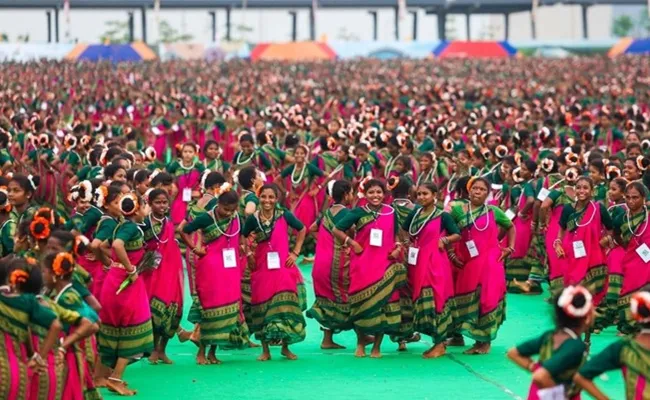
Prime Minister Narendra Modi’s inauguration of the Alluri Sitarama Raju International Airport at Bhogapuram on Saturday was meant to be a straightforward celebration. Instead, it’s turned into a debate over where cultural pride ends and political spectacle begins.
What happened at the ceremony
As part of the welcome programme, more than 13,000 students, women, and tribal performers took part in a mass performance of the Dhimsa dance, a traditional dance form associated with tribal communities in the region. The scale of the performance set a new Guinness World Record, surpassing an earlier record that involved close to 11,000 performers. Guinness World Records officials reportedly oversaw rehearsals ahead of the event to verify the attempt.
Modi praised the performance afterward, describing it as a reflection of Andhra Pradesh’s hospitality, cultural richness, and its tribal traditions.
The criticism
Not everyone read the moment the same way. Retired IAS officer P.V. Ramesh pushed back sharply in a social media post, arguing that Dhimsa isn’t just a performance piece for onlookers. He described it as a ritual carrying real spiritual weight for the tribal communities that practice it, and said turning it into a ceremonial welcome for political leaders crossed into disrespecting that tradition.
Ramesh went further, accusing the Andhra Pradesh government of turning indigenous cultural practices into a publicity exercise paid for with public funds, and specifically criticized using thousands of tribal girls to chase a world record. He called on Modi, Chief Minister N. Chandrababu Naidu, Deputy CM Pawan Kalyan, and Minister Nara Lokesh to apologise, saying the event had hurt tribal communities’ sentiments. His broader argument: governments would do more good investing in tribal communities’ education, healthcare, nutrition, and land rights than showcasing their culture at political events.
Not everyone agrees
The reaction hasn’t been one-sided. Some commentators have pushed back on Ramesh’s framing directly, pointing out that the Dhimsa dance is traditionally performed during rest periods from farm labor and matrimonial celebrations, and that tribal performers already dance it regularly for tourists in areas like Araku. From that view, a nationally televised performance isn’t desecration, it’s visibility, and criticism of the event has been dismissed by some as reflexive political point-scoring rather than a substantive objection.
Where this leaves things
Both sides of this debate touch on a real and recurring question in India: when a state showcases indigenous culture at a major public event, is it celebration, appropriation, or something in between, and who gets to decide? For now, neither the state government nor the central government has issued a formal response to Ramesh’s demand for an apology, and the airport’s Guinness World Record stands as officially confirmed.