


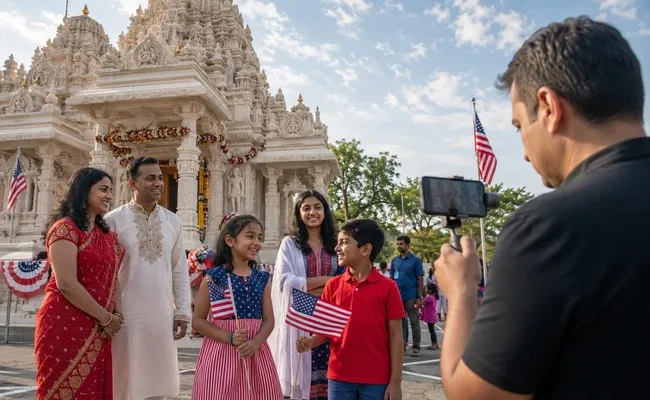
A July 4 celebration outside a Hindu temple in the U.S. has erupted into controversy after a pro‑MAGA influencer filmed and targeted children of H‑1B workers over their patriotism, sparking outrage across Indian‑American communities and beyond.
What happened outside the temple
The incident reportedly took place near a Hindu temple where families of immigrant tech workers had gathered, with children carrying or wearing Indian flags as part of a cultural and religious event.
A MAGA‑aligned social media influencer began filming some of these kids and questioned why they were holding the Indian flag instead of the American one, framing it as a test of loyalty ahead of Independence Day.
In the viral clip, the tone comes across as confrontational and accusatory rather than genuinely curious, turning a festive, family‑oriented gathering into a political flashpoint.
H‑1B families feel singled out
Many of the families present are H‑1B visa holders — high‑skilled immigrants who work largely in tech and related fields, often living in the U.S. for years while waiting for green cards.
Parents say their children were unfairly targeted and made to feel “less American” simply for participating in a cultural celebration with Indian symbols outside a temple.
For these families, the episode is especially painful: they pay taxes, follow the law and raise kids who grow up pledging allegiance at school, yet still find their belonging questioned in public spaces.
Culture, religion and patriotism collide
The controversy exposes a deeper tension in multicultural America:
- Indian‑American communities frequently celebrate cultural and religious events using Indian flags, traditional clothing and temple gatherings.
- Many also participate enthusiastically in July 4 parades, fireworks and civic ceremonies.
The influencer’s framing — that carrying an Indian flag on or around Independence Day is somehow unpatriotic — ignores how immigrant communities often juggle multiple identities: proud of their heritage, while also embracing American values and citizenship aspirations.
Social media outrage and support
Once the video surfaced online, it quickly triggered strong reactions:
- Indian‑American and broader South Asian communities condemned the targeting of children and called it harassment masquerading as “patriotism.”
- Others, including allies outside the community, pointed out the hypocrisy of demanding performative displays of loyalty from people whose legal status and livelihood already depend on strict compliance with U.S. rules.
At the same time, a section of right‑wing social media users cheered the influencer, arguing that “only the American flag matters on July 4,” sharpening the divide.
Fear of rising hostility
For many H‑1B families, the incident is not an isolated concern but part of a growing pattern where immigrants feel increasingly scrutinized, especially in the charged climate around elections and nationalism.
Parents worry that children may internalize a message that they must constantly prove they “belong” — at school, in public events and even outside their place of worship.
Some community leaders have started discussing practical responses: educating kids about their rights, coordinating with temples on security and recording policies, and building stronger ties with local authorities to ensure peaceful celebrations.
Larger questions for American society
Beyond the immediate outrage, the July 4 temple incident raises uncomfortable questions:
- Who gets to define what “patriotism” looks like in a diverse country?
- Are immigrant families allowed to celebrate both their heritage and America’s national holidays without being policed?
- How should platforms handle content that targets minors in the name of ideological confrontation?
As debates continue, one thing is clear: for many Indian‑origin families on H‑1B visas, this July 4 will be remembered not for fireworks in the sky, but for a confrontation outside a temple that exposed just how fragile a sense of safety and belonging can feel.
A community determined not to retreat
Despite the shock, community voices are already emphasizing resilience. Parents and temple organizers insist they will continue cultural and religious events, carry their flags and teach their children that being American can include honoring where their families came from.
In the long run, how this story is remembered may depend less on one influencer’s video, and more on how firmly immigrant communities, neighbors and local leaders push back against the idea that patriotism is a test you pass only by erasing who you are.