


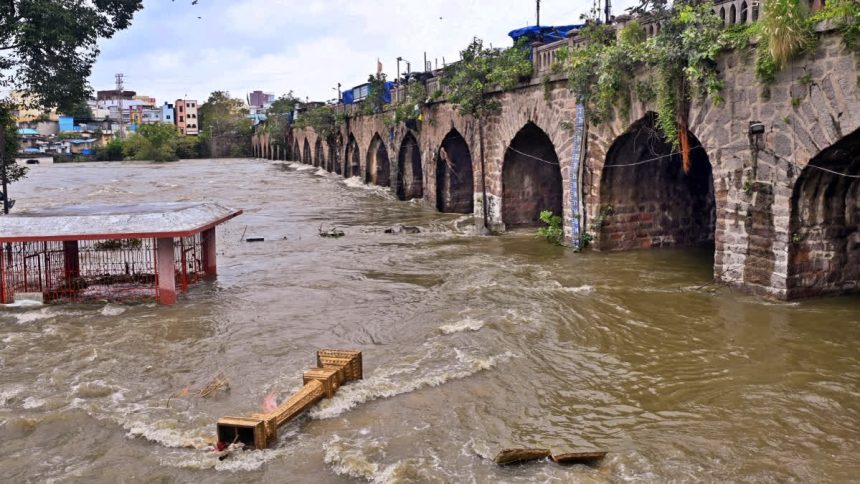
Medicines don’t just disappear once your body is done with them. Traces of them travel into rivers, and a new study says nowhere in India carries more of that chemical residue than Hyderabad’s Musi River.
A river full of leftover medicine
Researchers tested seven major river systems across Telangana, Tamil Nadu, and Kerala for 24 different pharmaceutical compounds. They found caffeine in every single sample collected, a clear sign that raw sewage is flowing straight into these waterways without treatment. But caffeine turned out to be just the start.
The Musi came out on top for total pharmaceutical contamination. It also ranked as the biggest hotspot for antimicrobial resistance, the process that lets bacteria evolve into drug-resistant superbugs. Painkillers like paracetamol showed the highest average concentrations among therapeutic drugs, followed by blood pressure medications and a range of antibiotics.
Urban stretches fared far worse than rural ones. The Musi in Hyderabad, along with Chennai’s Cooum and Adyar rivers, carried dramatically more contamination than the more rural Kaveri, Tamirabharani, Periyar, and Anjarakandy rivers.
The “ISIS drug” detail that stands out
One finding jumps out immediately. The Musi had the highest average concentration of tramadol of any river tested. The painkiller has occasionally made global headlines for reports linking it to ISIS fighters, who reportedly used it to fight fatigue during combat, and it picked up the nickname “the ISIS drug” in parts of the media as a result.
That’s not what’s happening here, though. Researchers say the tramadol levels point to heavy pharmaceutical contamination, likely tied to nearby drug manufacturing and distribution facilities, not to any criminal activity.
Why Hyderabad’s river looks so different
Hyderabad is one of India’s pharma capitals. The study notes the city hosts more than 250 pharmaceutical and biotech companies and over 300 manufacturing units, together producing close to 40% of India’s bulk drugs. The Musi absorbs untreated industrial effluent from 14 major industrial estates, including Jeedimetla and Bollaram, on top of roughly 600 million litres of city sewage every single day.
Using statistical modelling, researchers traced the pollution to three sources working together: untreated domestic sewage, pharmaceutical industrial discharge, and general urban wastewater. Every year, the river is estimated to carry over a thousand tons of telmisartan alone downstream toward the Krishna River and, eventually, the Bay of Bengal.
Why this matters beyond one river
Antibiotics lingering in water create exactly the conditions bacteria need to develop resistance. The lower Musi recorded the highest antimicrobial resistance risk of any site in the study, with risk levels for antibiotics like azithromycin and erythromycin crossing safety thresholds. Chennai’s Cooum River showed elevated risk too, but the Musi stood apart. It combines heavy industrial pharma discharge, untreated sewage, and the highest measured drug concentrations of any river studied.
It isn’t just a human health concern either. One compound, telmisartan, posed a very high risk to aquatic life, with concentrations at urban sites far above safe levels for fish and other organisms.
Is the drinking water actually safe?
Here’s the one piece of good news: researchers also tested groundwater and found nine pharmaceutical compounds present, but estimated health risks from drinking that water stayed below concerning levels for all age groups. Still, the study’s authors urge caution. Parts of the Musi are used as a drinking water source, and a contaminated river can still contribute to antimicrobial resistance spreading more broadly, even if the water itself tests as safe today.
What researchers say needs to happen next
The study lays out a few concrete fixes: treat open drains before they reach the river, require advanced wastewater treatment at pharmaceutical industrial clusters, and set up ongoing surveillance for antimicrobial resistance in polluted urban waterways.
The bigger takeaway is simple. Every pill swallowed and every untreated drain adds up somewhere downstream. Right now, the Musi is showing scientists exactly what that adds up to.