

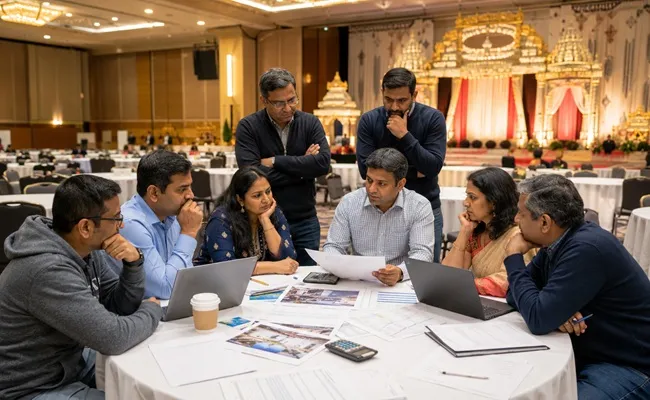
Every two years, tens of thousands of Telugu people scattered across America drop everything, book flights, pack their kids into minivans, and travel to one city to celebrate who they are. It is one of the most extraordinary displays of cultural pride anywhere in the world — a diaspora of software engineers, doctors, entrepreneurs and students coming together under one roof to eat, dance, argue, network and feel, just for a weekend, like they never left home.
This year, that city is Baltimore. The dates are July 31 to August 2. The event is the 19th ATA Conference.
And behind the scenes, the organisers are fighting a battle most attendees know nothing about.
The Money Problem Nobody Wants to Admit
Organising a convention of this scale comes with a daunting challenge: fundraising. Historically, a significant portion of convention funding has come from real estate sponsors — particularly developers from India.
Think about that for a moment. The Telugu convention in Baltimore is partly funded by apartment builders in Hyderabad and Vijayawada. That is how deep the NRI-homeland connection runs. Every glossy brochure at the convention, every stage light, every samosa at the welcome dinner — partly bankrolled by developers betting that NRIs will invest back home.
Except this year, that bet is getting harder to place.
The real estate sector is facing headwinds both in India and the United States, making sponsorship commitments harder to secure.
When builders are struggling, conventions feel it first.
The FBI and IRS Are Watching — And That Changes Everything
Here is where the story gets genuinely alarming for anyone who has ever donated to a Telugu association.
Another major funding source in the past has been corporate matching grants. However, following controversies and alleged misuse of matching grant schemes associated with certain organisations in recent years, regulatory agencies such as the FBI and IRS are reportedly keeping a close watch on grant-related activities.
Corporate matching grants — where a company matches an employee’s donation dollar for dollar — have long been a clever fundraising hack for Telugu associations. An engineer donates $500, their employer matches it, and the convention gets $1,000. Clean, legal, generous.
But not anymore.
Associations are now reluctant to rely heavily on this avenue, while many employees themselves are hesitant to participate due to increased scrutiny and compliance concerns.
When the FBI and IRS are in the picture, even well-meaning donations start to feel risky. The chilling effect is real — and it is costing Telugu conventions one of their most reliable income streams.
Tech Layoffs Have Hit the People Who Funded Everything
The Telugu diaspora in America is built, to a significant degree, on the technology industry. Silicon Valley, Seattle, Austin, New Jersey — these are Telugu towns in all but name. And right now, those towns are hurting.
High-earning technology professionals, who often contribute generously and take active leadership roles in convention planning, are currently navigating an uncertain employment environment. Amid ongoing layoffs and corporate restructuring across the technology sector, many are prioritising financial prudence over discretionary spending and philanthropic commitments.
The people who used to write the big cheques are now watching their LinkedIn feeds fill with “open to work” banners from colleagues. The people who used to chair convention committees are now wondering if they will have a job by the time the convention actually happens.
Even spending valuable time on activities beyond work is often perceived by some as unnecessary or unproductive.
When your H1-B status depends on staying employed, volunteering for a convention planning committee feels like a luxury you cannot afford.
Everything Costs Double. Sometimes Triple.
And if the funding crisis was not enough, the bills have gone through the roof.
The cost of hosting large-scale events in the United States has risen dramatically over the past two years. Venue rentals, logistics, hospitality, entertainment and operational expenses have either doubled or, in some cases, tripled. Consequently, organisers must raise substantially more funds than in previous conventions merely to maintain the same scale and quality.
Less money coming in. More money going out. That is the impossible equation the ATA organisers are trying to solve between now and July 31.
Why This Convention Matters More Than You Think
It would be easy to dismiss this as an internal community headache. Convention politics, fundraising drama — who cares?
But that would be missing the point entirely.
These conventions are the beating heart of the Telugu diaspora. They are where second-generation kids discover Kuchipudi for the first time. Where retired professors from Guntur meet startup founders from San Jose. Where a young Telugu student who arrived six months ago suddenly realises she is not alone in a foreign country.
They are also where political connections are made, business deals are sealed, and the relationship between the NRI community and the AP/Telangana governments is quietly negotiated.
The success or failure of the 19th ATA Conference could serve as a benchmark for future Telugu conventions across North America — offering valuable lessons on how diaspora organisations adapt to changing economic realities.
In other words — if ATA Baltimore struggles, every Telugu convention that comes after it will be watching and learning the hard way.
The Question That Deserves an Answer
The Telugu community in America has overcome extraordinary challenges. Visa uncertainty, discrimination, pandemic years, and now this — a perfect storm of regulatory scrutiny, tech layoffs, real estate slowdown and runaway inflation.
But here is the thing about Telugu people: they figure it out.
The question is not whether the 19th ATA Convention will happen. It will. Thousands of families will still drive to Baltimore, still wear their silk sarees in August humidity, still argue about which city makes better biryani, still cry during the cultural performances.
The question is: what comes after? How does the community rebuild its funding models, clean up the matching grant controversy, and create a convention ecosystem that does not depend on real estate booms and big tech salaries?
That is the conversation the Telugu diaspora needs to have — not just in Baltimore in July, but right now, before the next perfect storm arrives.