

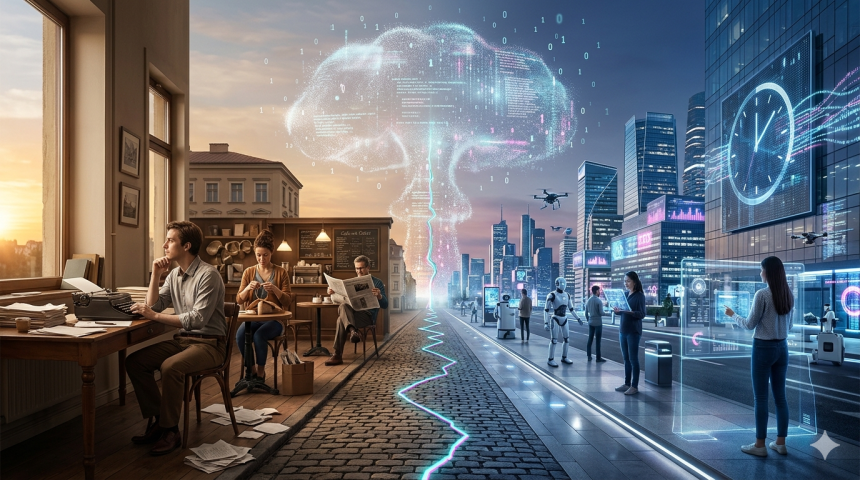
Artificial intelligence is no longer a distant idea reserved for science fiction or tech conferences. It is already reshaping jobs, media, business, education and public life, quietly and steadily, which is why many observers now see it as a slow-motion atom bomb on Earth.
That phrase may sound dramatic, but the concern behind it is real. AI is not likely to create one sudden blast; instead, it is changing society in stages, replacing tasks, rewriting workflows and shifting power in ways that are easy to miss until the damage is already visible.
A disruption in plain sight
The most unsettling thing about AI is that its impact is often invisible at first. A company adopts a tool to save time, a newsroom uses software to speed up production, a business automates customer support, and a design team leans on machine-generated output — each decision seems small on its own.
But over time, these small shifts add up. Entire categories of work begin to shrink, while the demand grows for people who can supervise, interpret and refine what machines produce. What looks like efficiency today can become displacement tomorrow.
Why the fear is growing
AI is not only about automation. It is also about control, speed and scale. A single system can now generate text, images, voice, video and analysis faster than human teams, and that changes the balance of power in almost every industry.
The risk is not limited to jobs. AI can also be used to spread misinformation, create deepfakes, manipulate opinions and overwhelm people with synthetic content that looks real. In a world already struggling with trust, that is a serious problem.
The hidden cost of convenience
Every new technology promises convenience, but AI’s convenience comes with a deeper cost. The more people rely on it, the more it starts shaping what they read, watch, believe and decide.
That creates a new kind of dependency. Businesses may become faster, but also more vulnerable to errors they do not fully understand. Individuals may become more productive, but less capable of spotting falsehoods or making independent judgments. In that sense, AI is not just a tool — it is a force that quietly influences behavior.
The jobs question
The biggest anxiety around AI is employment, and that fear is not misplaced. AI may not eliminate every job, but it is likely to change many roles beyond recognition, especially in fields built on repetitive or process-driven work.
The winners will be those who adapt quickly and learn to use AI as an assistant rather than a threat. The losers may be workers and sectors that cannot adjust fast enough. That gap could widen inequality unless governments, schools and companies prepare people for the transition.
Regulation and responsibility
The mistake would be to treat AI as either a miracle or a monster. It is neither. It is a powerful technology, and like any powerful technology, its effects depend on how it is used and who controls it.
That is why regulation matters. Transparency, accountability and digital literacy are no longer optional; they are essential. Without them, AI could deepen mistrust, weaken institutions and make society more fragmented.
The bigger warning
The “slow-motion atom bomb” metaphor works because it captures AI’s true danger. It is not destruction by explosion, but destruction by accumulation. It changes systems gradually, until one day the scale of the shift becomes impossible to ignore.
AI is already transforming the world. The real question is whether people will guide that transformation wisely — or wake up too late to realize how much has already changed.