


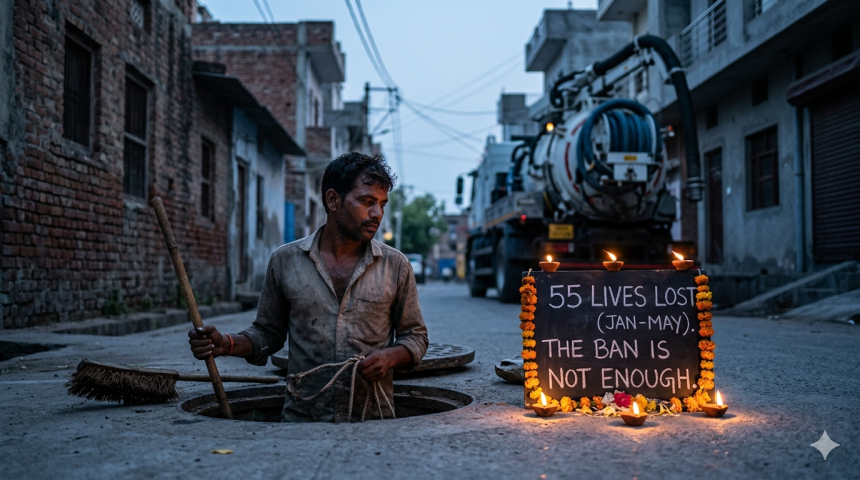
India’s ban on manual scavenging has not ended the danger — or the deaths. A new survey has found that 55 sanitation workers lost their lives in the first five months of the year while cleaning sewers and septic tanks, underlining how the country’s most degrading and hazardous sanitation work continues despite repeated promises of reform.
The numbers are shocking not only because of how high they are, but because they expose a grim reality that keeps returning year after year. The deaths are happening in cities and towns where mechanisation is supposed to have replaced human entry into toxic drains, yet workers are still being sent into deadly spaces with little protection.
The human cost
Behind every statistic is a family left behind, often without adequate compensation, support or accountability. The survey shows that sanitation workers remain trapped in a system where the risks are extreme and the safeguards are weak, even though the work itself is illegal in its most dangerous form.
That is what makes this story more than a labour issue. It is a social justice issue, a public health issue and a governance issue all at once. When workers die cleaning sewers, it is not an accident of fate — it is usually the result of negligence, poor enforcement and the continued normalisation of unsafe practices.
A ban that has not worked
Manual scavenging has long been banned in India, but the practice has not disappeared in reality. Instead, it has often shifted forms, continuing through hazardous sewer and septic tank cleaning that still relies on human entry in many places.
This gap between law and ground reality is the core failure. Official policy says the practice should not exist, but the repeated deaths show that enforcement remains uneven and accountability limited. In many cases, safety equipment is inadequate, emergency response is slow and the workers most exposed to danger have the least power to refuse.
Why the deaths continue
The persistence of these deaths points to a broader problem: sanitation work is still treated as low-value work, even when it is essential to urban life. That attitude makes it easier for contractors and local bodies to cut corners, ignore safety rules or underinvest in mechanised cleaning.
It also reflects how deeply caste and labour inequalities remain embedded in the system. The people who are pushed into this work are often among the most marginalised, which means the danger is not distributed evenly — it falls repeatedly on those with the fewest protections.
What the survey reveals
The survey cited in the report is important because it shows how the crisis is not hidden in isolated incidents. It is widespread enough to be measured in dozens of deaths in just a few months, which suggests a continuing pattern rather than a one-off failure.
That makes the policy response even more urgent. Laws alone cannot stop these deaths unless every level of government is forced to monitor contractors, punish violations and ensure that no worker is made to enter a sewer without proper machinery and safeguards.
The bigger question
India has made major claims about sanitation progress, urban cleanliness and infrastructure development. But the latest figures show that the country still has not solved the most basic question of dignity: why are workers still dying to clean what machines should handle?
Until that question is answered with real enforcement and accountability, the crisis will continue to haunt the country’s cities. The numbers may change from year to year, but the pattern remains the same — too many deaths, too little reform, and far too much silence around a practice that should already be history.