


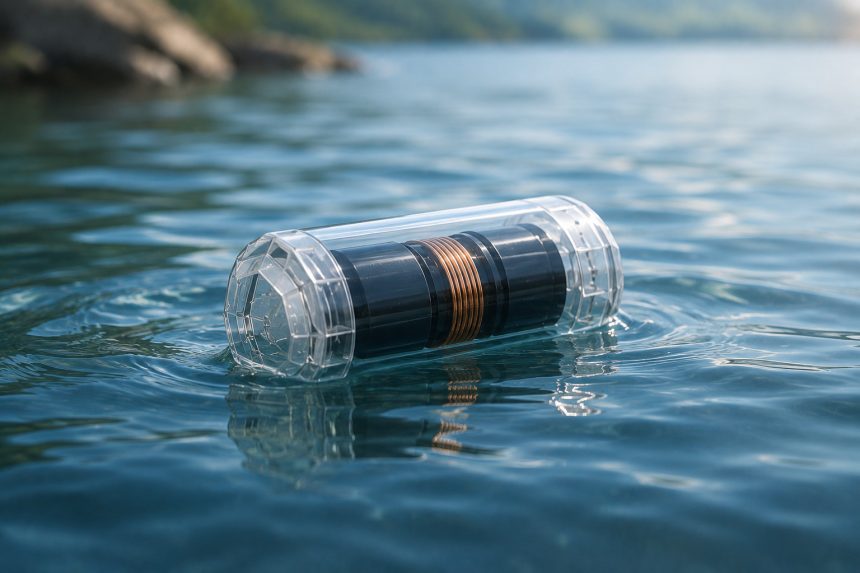
Researchers at Yonsei University have developed a hand-held floating device that harnesses the energy of human motion — and the physics of static electricity — to detect contamination and disinfect drinking water, with implications for 2.1 billion people who still lack safely managed water access.
More than two billion people on earth still cannot reliably access safe drinking water. For communities enduring drought, displacement, floods, or the quiet collapse of ageing municipal infrastructure, the choice between available options has long been one of imperfect trade-offs: boiling consumes fuel; chlorine tablets leave an aftertaste and cannot remove chemical contaminants; commercial filters clog, break, and require consumables that are often unavailable where they are most needed. Against this backdrop, a team of engineers at Yonsei University in Seoul has demonstrated something quietly remarkable — a small floating capsule, described in the journal Nature Water, that a user activates simply by shaking it in their hand.
The device needs no battery, no solar panel, no chemical additive, and no connection to any power grid. Instead, it draws on two principles of physics that cost nothing to invoke: electromagnetic induction and contact electrification. The result is a self-contained, hand-powered instrument that first tests water for likely chemical risk, then proceeds to kill the microbes in it — all within half an hour for a one-litre sample.
How it works — the physics
A magnet moves through a copper coil during shaking, generating current via electromagnetic induction to power the sensor and Bluetooth chip. Once floating, wave-driven contact between water and the plastic shell builds up triboelectric charge. Electrode-coated nanorods — 40 nm wide — concentrate that charge into intense local electric fields, which rupture microbial membranes through electroporation.
The sequence begins with three seconds of shaking. Inside the capsule, a small permanent magnet slides back and forth through a copper coil — the same principle that underlies every electric generator, operating at the scale of a human palm. The induced current is modest, but sufficient to activate a sensor that measures total dissolved solids, or TDS, in the water. The TDS reading serves as a rough chemical safety indicator: if dissolved material exceeds 250 milligrams per litre, the device transmits a warning via Bluetooth, flagging the water as unsuitable for treatment by the capsule alone. Chemical contamination of that degree — arsenic runoff, industrial effluents, pesticide residues — is beyond what any microbial disinfection tool can address.
If the water falls below that threshold, the capsule proceeds to its second function. Placed on the water surface, it begins to generate electricity of an entirely different kind. As waves move the device up and down, water molecules repeatedly make contact with and then separate from the plastic shell. This mechanical action builds up a triboelectric charge — the same phenomenon that produces static electricity when a balloon is rubbed against hair — and the opposing surfaces develop complementary electrical potentials.
“We have developed a new concept of a self-powered water safety platform that can verify potential contamination right before drinking and remove pathogenic microorganisms without external power or chemicals.” — Prof. Sang-Woo Kim, Yonsei University
What makes the device scientifically distinctive is what happens at the capsule’s outer surface. Affixed to its electrodes are polymer nanorods approximately 40 nanometres in diameter — roughly one-thousandth the width of a human hair. At that scale, the geometry of the rod tips concentrates the accumulated triboelectric charge into extraordinarily intense local electric fields. These fields are not merely impressive in the abstract; they are strong enough to cause electroporation — the physical rupturing of holes in the outer membranes of bacteria and viruses.
Laboratory results, and what they showed
The researchers tested the capsule against three organisms commonly used to assess water disinfection technology. Escherichia coli and MS2 bacteriophage — the latter a virus surrogate widely employed in water quality research — were eliminated from one-litre samples within 20 minutes. Bacillus subtilis, a more resilient spore-forming bacterium, required approximately 25 minutes. In more demanding field-equivalent tests, using tap water, river water, and lake water rather than controlled laboratory media, complete disinfection of one-litre samples was achieved within 30 minutes. A four-litre batch of river water took 52 minutes.
The team also assessed how well the device held up over time. The capsule maintained its performance through 120 repeated disinfection cycles in four litres of river water, and the researchers reported the formation of almost no harmful chemical byproducts — a significant concern with other electrochemical disinfection methods, which can generate chlorate compounds or other oxidants at biologically significant concentrations.
Scope, and the limits that matter
The study is careful not to overstate what the capsule can do. Electroporation destroys microbes; it does not neutralise arsenic dissolved in groundwater, nor does it degrade organophosphate pesticides, remove heavy metals, or address the class of pharmaceutical residues now detected in water bodies across South Asia and elsewhere. In areas affected by industrial pollution, mining runoff, or agricultural chemical use, microbial disinfection alone is insufficient, and the device’s own TDS threshold is intended to flag — rather than solve — that problem.
The estimated manufacturing cost of under $25 per unit is a figure worth holding with some caution: it represents a laboratory estimate, not a production-line reality. Scaling a device that incorporates polymer nanorods and precision-engineered coils into a supply chain capable of reaching remote communities in flood-affected Bangladesh, drought-struck villages in the Sahel, or earthquake-response camps is an engineering and logistics challenge of a different order from demonstrating efficacy in a controlled experiment.
Nevertheless, the underlying concept addresses a genuine gap. Existing point-of-use water treatment tools almost universally depend on either chemical inputs — whose supply chains can fail precisely when they are most needed — or electricity, which may be unavailable for the same reason. A device that harvests mechanical energy from the motion of human hands, and uses it to power both a safety check and a disinfection process, represents a design philosophy that aligns more naturally with the constraints of disaster relief, remote settlements, and off-grid communities than most of its predecessors.
The research, led by Professor Sang-Woo Kim of Yonsei University, was published in Nature Water on June 8, 2026. It is unlikely to be the last word on self-powered water treatment — but it may be among the more credible first ones.