

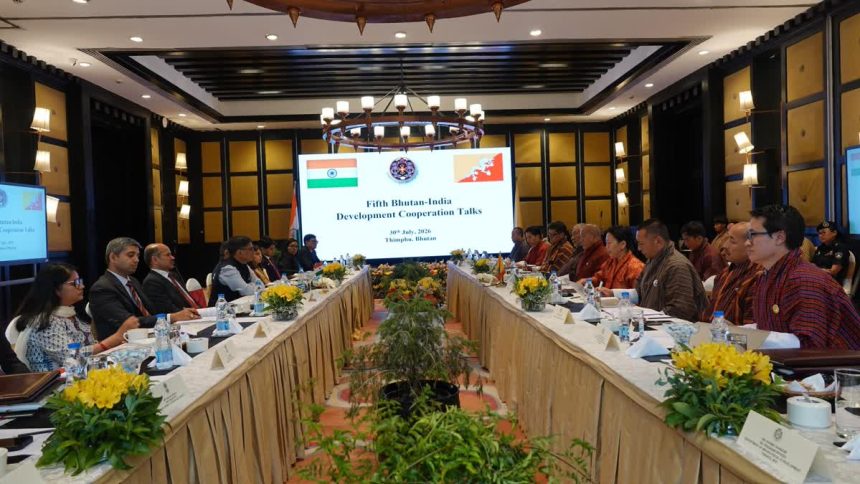
India and Bhutan are expanding their long-standing hydropower partnership into a broader clean-energy and green-development agenda. While big hydro projects remain the core, both governments are now pushing solar, green hydrogen, cross-border power trading and infrastructure planning up to 2040.
Hydropower: The backbone of the relationship
Hydropower cooperation between India and Bhutan started in the 1960s and has since become the centrepiece of bilateral economic ties. Key milestones include:
- Operational projects: Chukha (336 MW), Kurichhu (60 MW), Tala (1,020 MW), Mangdechhu (720 MW) and Punatsangchhu-I (1,020 MW) have boosted Bhutan’s installed capacity to around 3,490 MW, with most capacity developed through India-supported inter-governmental projects.
- Ongoing and upcoming projects: Punatsangchhu-II (1,020 MW) and the 1,200 MW Punatsangchhu-I expansion are central to current discussions, along with long-planned projects like Sankosh.
- Financing model: India has provided a mix of grants and concessional loans, including a ₹4,000 crore line of credit for Bhutan’s hydel sector, and is now backing new joint-venture models such as the 600 MW Kholongchhu project.
Electricity trade follows a seasonal pattern: Bhutan exports surplus power to India during the monsoon and imports during the lean season, with both sides working to streamline scheduling and improve grid stability.
Beyond hydro: Solar, green hydrogen and storage
In recent high-level meetings, India and Bhutan have agreed to diversify their energy cooperation:
- Solar and wind: New MoUs aim to develop solar parks and small-scale wind projects, with Indian firms partnering Bhutan’s Druk Green Power Corporation (DGPC) and Druk Holdings & Investments (DHI).
- Green hydrogen: Both countries are exploring pilot projects for green hydrogen production, using Bhutan’s clean electricity to produce hydrogen for export and domestic use.
- Energy storage: Discussions cover battery storage and pumped-storage options to manage variability and enhance cross-border power flows.
This shift reflects Bhutan’s desire to reduce over-reliance on a few large hydro projects and India’s push to integrate more renewable energy into its grid while meeting climate commitments.
Transmission planning up to 2040
Senior officials from both sides have started work on a long-term transmission roadmap:
- Planning cross-border lines and substations to handle higher renewable capacity
- Upgrading interconnections to support smoother power scheduling, especially during lean months
- Aligning infrastructure with projected growth in solar, hydro and potential green hydrogen exports
The goal is to ensure that power trade can scale steadily over the next 15 years without bottlenecks.
Why this matters
For Bhutan, hydropower remains a major source of export revenue and economic growth. Diversifying into solar, green hydrogen and storage can create new income streams and reduce vulnerability to climate-related risks such as glacial lake outburst floods (GLOFs) and changing rainfall patterns.
For India, Bhutan’s clean electricity supports its renewable energy targets, helps balance the grid and reduces dependence on fossil fuels. A broader green partnership also strengthens strategic ties and showcases a regional model of climate-friendly development.
What to watch next
- Final investment decisions and construction timelines for Punatsangchhu-I and other stalled hydro projects
- Concrete solar and green hydrogen pilots under the expanded India–Bhutan clean-energy MoUs
- Progress on the 2040 transmission master plan and new cross-border interconnectors
- How both governments balance large hydro with environmental and community concerns
As the relationship moves from “hydro-only” to a multi-source green partnership, India and Bhutan are positioning themselves as a key clean-energy corridor in South Asia.