

The Middle East was hours away from a deal that could end one of its bloodiest conflicts in decades. Then Israel struck Beirut — and everything nearly fell apart.
Smoke Over Beirut on What Could Have Been Peace Day
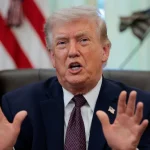
US President Donald Trump on Sunday urged no further attacks by anyone after Israel’s military launched strikes on Hezbollah targets in Beirut, potentially complicating efforts to finalise a deal to end the US-Iran war.
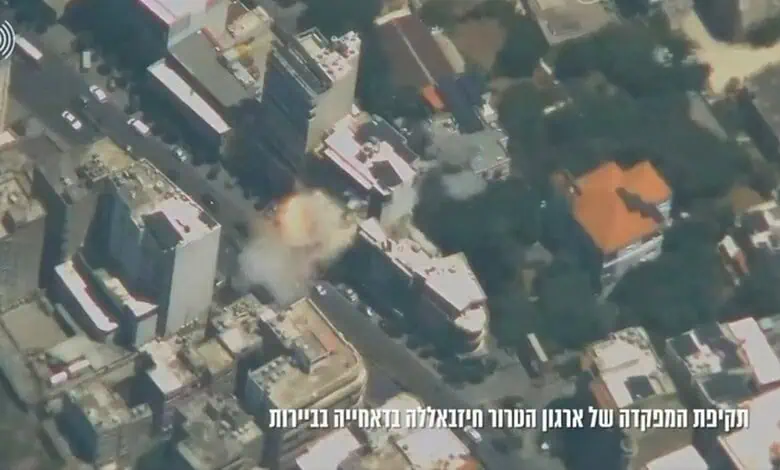
Smoke rose over the Lebanese capital. Civil Defence teams retrieved three bodies and six wounded people from the rubble of a five-story apartment building — two of its lowest floors completely destroyed, its residents fleeing into the streets.
Trump’s response? Not a phone call. Not a diplomatic note. A social media post: “We are very close to a Deal that will bring peace to the region. Let’s not blow it!”
Three words. The fate of a region, apparently, resting on them.
Netanyahu vs. Trump: The Alliance That’s Cracking
This is no longer a situation where America and Israel are reading from the same script. Trump had said the deal could be signed Sunday and had pressed Israeli Prime Minister Benjamin Netanyahu to stop hitting Lebanon hard while a deal is near — but Netanyahu has defied him.
Netanyahu’s office said the strikes were in direct response to Hezbollah attacks on northern Israel, with Israel’s military releasing footage showing an audible boom followed by rising smoke. Netanyahu and Defence Minister Israel Katz were blunt: “Israel will not tolerate firing into its territory.”
But here’s the uncomfortable truth underneath that statement — the deal in its current form is a deep disappointment to Israel’s government, which has been sidelined in negotiations led by Pakistan and others. Israel is watching a peace framework take shape that it had no real hand in building — and Netanyahu appears to be doing the only thing he can: making sure no one forgets Israel is still in the room.
Iran’s Patience Running Out Fast
Tehran was not in a forgiving mood on Sunday. Iran threatened a military response after the Beirut strikes, and its parliamentary Speaker Mohammad Bagher Qalibaf — one of Iran’s lead negotiators — went straight to social media with a pointed warning to Washington: “If you lack the will and ability to fulfill your commitments, speaking of continuing the path is not possible.”
Translation: America, control your ally — or this deal dies.
Iran’s military was equally direct. General Mohammad Jafar Asadi, deputy commander of Iran’s Joint Command Headquarters, said flatly that “without a doubt, these crimes will not go unanswered.”
How Close Is This Deal, Really?
Remarkably — despite all of this — the deal is still alive. Barely, but alive.
Qatari mediators flew to Tehran on Sunday to try to finalise the agreement. Two regional officials, speaking on condition of anonymity, expressed cautious optimism that the US and Iran were finally approaching a deal that could halt hostilities that have killed thousands of people and reopen the Strait of Hormuz — whose closure has thrown global markets into disarray.
Pakistani Prime Minister Shehbaz Sharif said Saturday the deal would be signed Sunday. Iran’s foreign ministry spokesperson said it could happen in the coming days. Trump said the Strait of Hormuz would reopen immediately after the signing.
The deal is expected to be signed electronically, without an in-person ceremony — a quiet, almost anticlimactic conclusion to a war that has been anything but.
What the Deal Actually Does — and Doesn’t Do
Before anyone declares victory, it’s worth understanding what’s actually on the table. The agreement does not resolve the thorniest issues — Iran’s nuclear programme or its billions in frozen funds. Instead, it offers a 60-day framework for technical discussions on those questions.
Under the deal being discussed, the US and Israel appear to have fallen short of their original goals: destroying Iran’s missile and nuclear programmes and ending its support for armed proxies across the region.
Iran, for its part, holds 440.9 kilograms of uranium enriched to 60 per cent purity — a short technical step from weapons-grade levels of 90 per cent, according to the International Atomic Energy Agency. Iran has long maintained its nuclear programme is peaceful and has not publicly committed to surrendering the enriched uranium, which is believed to be buried beneath three nuclear sites badly damaged by US strikes last year.
Meanwhile, Trump posted on Saturday that once things calm down, the US would go in and “downblend and destroy” Iran’s enriched uranium — a claim Iran has not acknowledged, let alone agreed to.
The World Is Watching — and Waiting
Trump is expected to raise the demining of the Strait of Hormuz at the Group of Seven summit beginning Monday, June 15 — underlining just how far the economic consequences of this conflict have rippled beyond the Middle East.
The Strait of Hormuz carries roughly a fifth of the world’s oil. Every day it stays closed, fuel prices climb, shipping routes stretch, and the pressure on diplomats intensifies.
Sunday was supposed to be the day it ended. Israel struck Beirut. Iran threatened retaliation. Trump fired off a social media post asking everyone to calm down.
The deal isn’t dead. But it has never felt more fragile.
— With inputs from Associated Press, Jerusalem, June 14, 2026